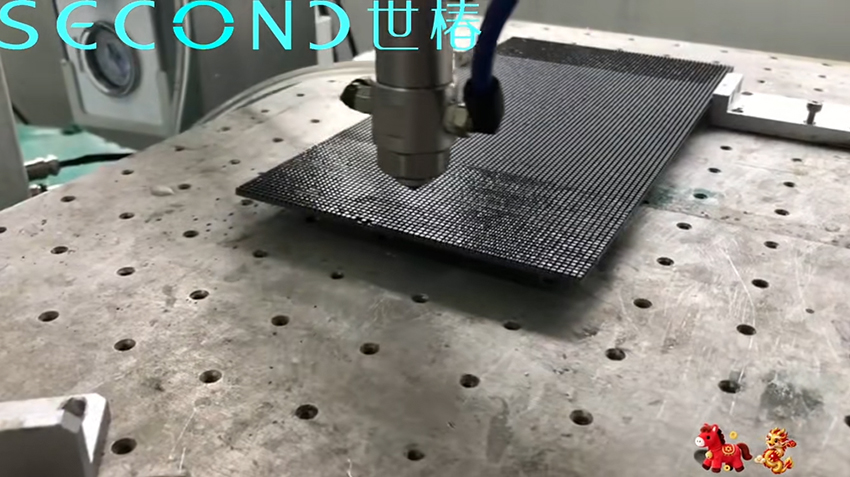
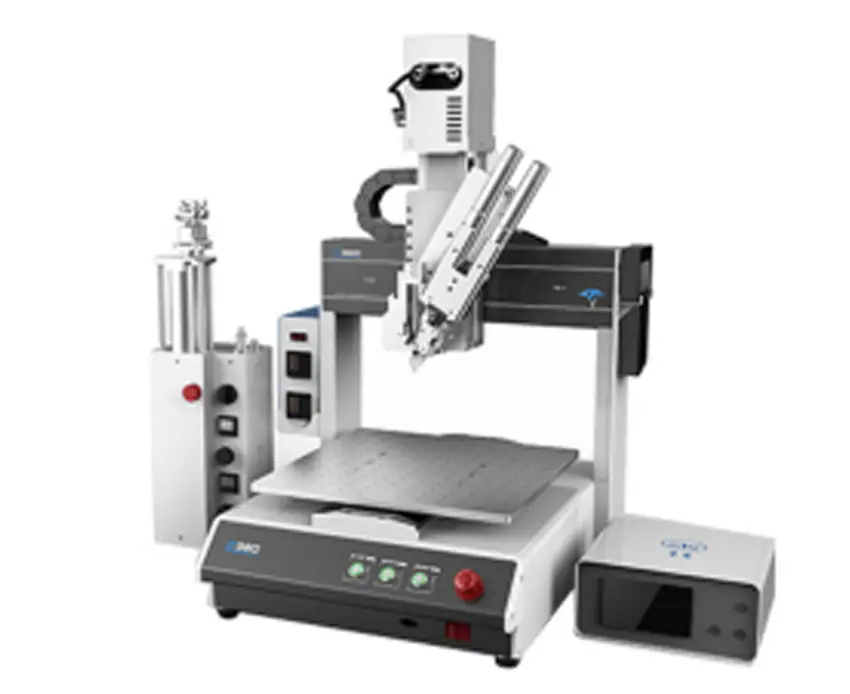
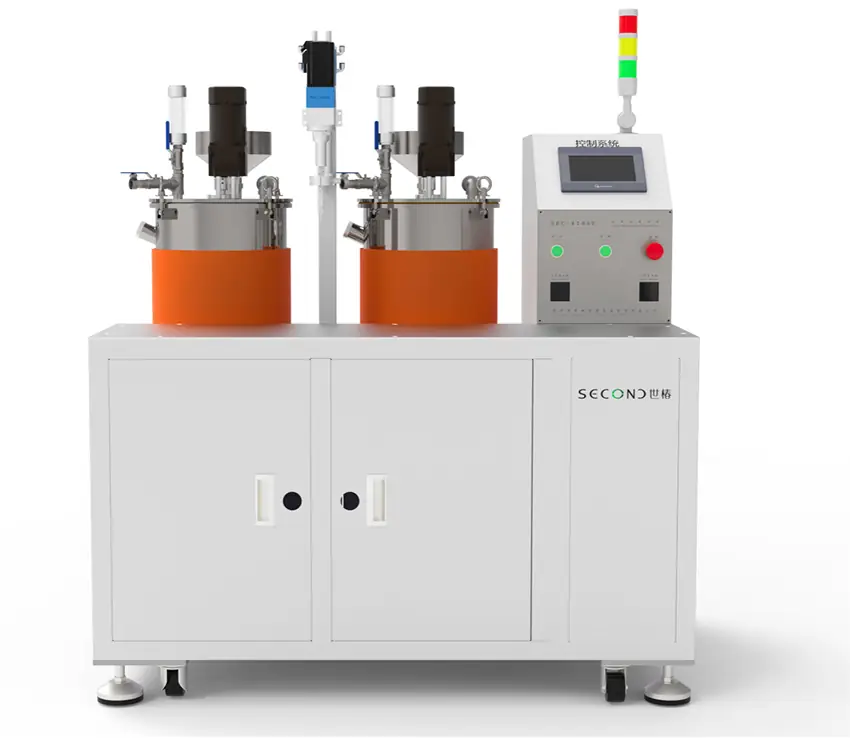
In short: the SEC-S8700-E from Second Intelligent automates metering, dynamic mixing and shot size on 1 servo metering unit, and leaves part handling to the operator. It is built in 4 kinematic configurations with 2 optional workbenches, so sampling work and multi-variant low-volume projects do not have to start with a fully automatic potting line.
1. What does “manual” remove — and what stays automated?
Manual covers part handling only: the operator loads the part, starts the cycle and unloads it. The A:B ratio, the mixing and the shot size are all performed by the machine.
Components A and B are each fed by their own servo metering motor under PLC control, so the ratio is a value set on the HMI rather than a judgement made by eye. The two components meet in a mixing section ahead of the valve, and each shot is executed to the stored recipe.
Get those three steps right and the base of potting yield is already stable. What the operator still controls is cycle time, not ratio or shot weight.
Task | SEC-S8700-E (semi-automatic) | Fully automatic potting line |
Part load / unload | Operator | Robot or conveyor |
A:B ratio | Servo metering motors, closed-loop under PLC | Same metering principle |
Mixing | In-line mixing section ahead of the valve | Same mixing principle |
Shot size | Executed shot by shot from the recipe | Executed shot by shot from the recipe |
Motion | 1 of 4 configurations, selected by part | Robot plus conveyor locating |
Where the budget goes | Mainly the metering and mixing unit | Plus handling, conveying, guarding |
Changing product | New fixture, new recipe parameters | Whole-line process revalidation |
2. Why do four kinematic configurations map onto four families of parts?
Every model in the range reuses the same high-precision metering and mixing unit: the metering servo motors, the dynamic mixing module and the flow-control logic are identical. Only the motion hardware is configured differently.
Selection therefore follows the physical properties of the part, the dispensing path and the locating conditions — not the equipment tier. What really differs between configurations is cost and cycle time; the potting principle underneath does not change.
Configuration 1 — Fixed valve, moving part: lowest cost, consistency handed to the fixture
No linear slide and no rotary servo module, so hardware cost is the lowest of the four. The operator positions the part or fixture under the valve, runs one cycle, then repositions it by hand for the next dispense point.
This suits small and medium parts with a simple seal outline and a limited number of dispense points. The limit is repeatability: position depends on the positive location of the fixture, so fixture repeatability tolerance has to be controlled up front, or manual judgement turns directly into shot-to-shot variation.
Configuration 2 — Fixed valve, rotary platform: ring quality depends on four coupled parameters
The valve body stays locked while the part turns on a servo rotary fixture, and dispensing is synchronised with angular velocity. The result is a closed circumferential bead or a metered fill of an annular cavity.
Typical parts are cylindrical and rotationally symmetric components and motor assemblies that need circumferential sealing. During commissioning, angular velocity, dispense rate, part diameter and adhesive rheology have to be matched as a set; otherwise bead overlap, broken beads or overflow appear.
Configuration 3 — Fixed part, moving dispensing head: first choice for complex paths and heavy parts
The part is clamped on a datum fixture and stays still while the dispensing head follows a programmed Cartesian path. Two heads can be driven independently, so several areas of the same part are dispensed in one setup with no re-clamping.
This fits multiple discrete dispense points, irregular dispensing paths, and parts that are too large or too heavy to move by hand. Head travel, repeatability and dispense sequencing are all parameterised from the part model and the process specification.
Configuration 4 — Cantilever gantry valve: part stays still, scattered points still get a continuous bead
The valve rides a cantilever motion module that travels in multiple axes through the working envelope, while the part remains stationary throughout.
For heavy parts with awkward clamping and widely separated dispense points, the whole area can be covered without repeated loading and unloading. It suits cases with more than one pour point where a continuous, controlled bead path is required.
3. Why is the workbench a separate option rather than a bundled one?
The workbench is a decision parallel to the kinematic configuration. It follows from how the part is located and loaded, and it is not tied to any one configuration.
If the part can sit directly on the machine base, or the customer already has fixtures that can be reused, the workbench is dropped: smaller footprint, lower capital cost.
Add it when a dedicated locating fixture is needed, when loading takes two hands, or when a buffer position for work in progress is useful. The table size is then built to the physical envelope of the part and its fixture.
4. What does a low-volume buyer actually save with a semi-automatic machine?
A semi-automatic machine is not a reduced version of the process. It strips out the automated handling hardware and puts the budget into the two units that decide yield: metering and mixing.
1.Lower initial CAPEX. No robot handling, no conveyor system, no full-line safety fencing; the core budget goes to ratio metering and dynamic mixing.
2.Product changes do not touch the line. A changeover means new fixtures and new recipe parameters, not a full process revalidation, and one machine covers several sizes within the same product family.
3.The yield-critical steps are still automatic. Hand mixing fails in two predictable ways: ratio drift and entrained air. Servo metering removes the first; optional vacuum feeding, vacuum degassing, heating, stirring and automatic cleaning address the second.
4.The structure grows with the order book. Material preparation modules, custom fixtures and workbench modules can be added to the same machine body later.
5.Automation is justified with measured data. Run trial production on this machine first, record real cycle time and PPM defect rate, and use those figures to size the automatic line instead of a forecast.
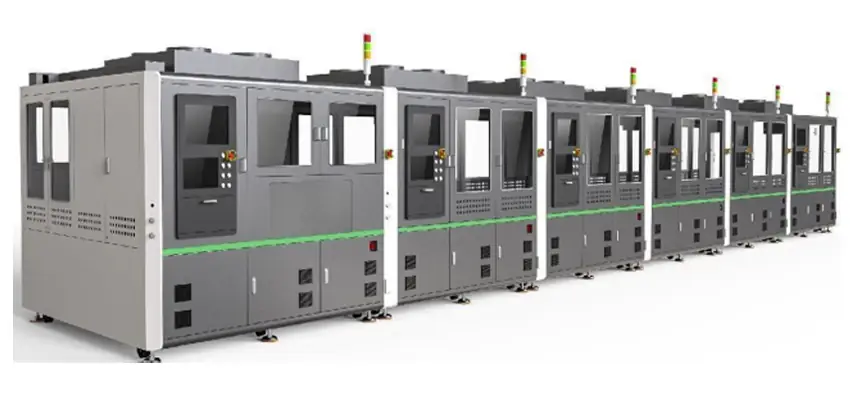
One point worth stating up front: the same machine body can be extended module by module, but moving to a fully automatic line still means replacing the machine. Floor space and material flow for that line should be reserved at the planning stage.
5. What five inputs does a custom build need before the first review?
Configuration quality depends on process data. Five inputs are enough to complete the first engineering review.
1.The part: photo, overall dimensions, weight, and a drawing that marks the potting boundary.
2.The adhesive: chemistry, supplier grade, full TDS, viscosity, theoretical mix ratio and pot life.
3.The potting requirement: dispense points, bead path outline, shot weight per part, acceptable cycle time.
4.The volume plan: daily output, shift pattern, and how often models are changed over.
5.The loading method: manual loading, fixture clamping, or a rotary fixture platform.
With those in hand, the first review usually settles the kinematic configuration, the workbench option and the material preparation modules in one pass, saving a round of back-and-forth.
6. Frequently asked questions
How is ratio consistency guaranteed on a semi-automatic machine?
By closed-loop control of the PLC-driven servo metering motors, independent of the operator. Each component is fed by its own motor and mixed ahead of the valve, with the ratio preset digitally on the HMI; pump and valve output stay stable within their design life, provided the ratio is verified and logged during commissioning and scheduled maintenance.
Cantilever gantry or rotary platform — which one?
Follow the bead path, not the part size. If the path is a closed contour around a single axis, choose the rotary platform; if the valve must reach several discrete points in space along a continuous path, choose the cantilever gantry valve.
When should a fully automatic line replace it?
There is no fixed volume threshold. Compare the full manual cycle time with the takt time the order requires; automation only pays back once manual loading, unloading and transfer have become the main constraint of the cycle.
Can it be upgraded to a fully automatic line later?
At module level, yes: material preparation, custom fixtures and workbenches can all be added. Replacing it with a full line is a different machine, which is why floor space should be reserved during planning rather than after capacity runs out.
7. Send us your process data
Reliable two-component potting does not have to start with a fully automatic line.
Send the part documentation, the adhesive TDS and the shot weight per part, and the Second Intelligent application engineering team will return a complete proposal covering kinematic configuration, workbench option and material preparation modules. Commercial quotation follows once the proposal is approved.
Second Intelligent — fluid application equipment partner for precision dispensing, potting and coating.