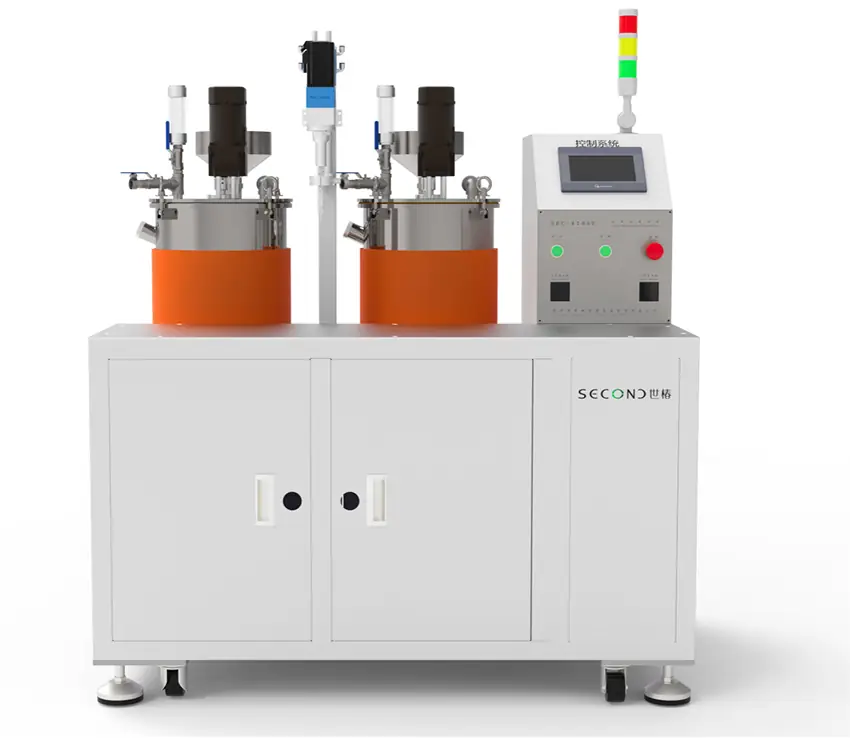
Key takeaway: In wire harness manufacturing, connector potting and cable outlet sealing use a two-component dispensing machine with vacuum degassing. Under GB/T 4208, protection ratings of IP67/IP68 can be verified. One-component silicone solutions are better suited to low-volume production and rework; selection is determined by the adhesive dispensing system, cavity depth, and cycle time.
Why Dispensing and Potting Are Essential in Wire Harness Manufacturing: Four Failure Pathways Define the Process Value
In automotive, new-energy vehicles (EV), industrial automation, home appliances, aerospace, and communications equipment, wire harnesses are the “nervous system”; connectors and contact points are the most failure-prone weak links. As electrical architectures become more compact, requirements for ingress protection (IP), dielectric insulation, and long-term durability continue to tighten.
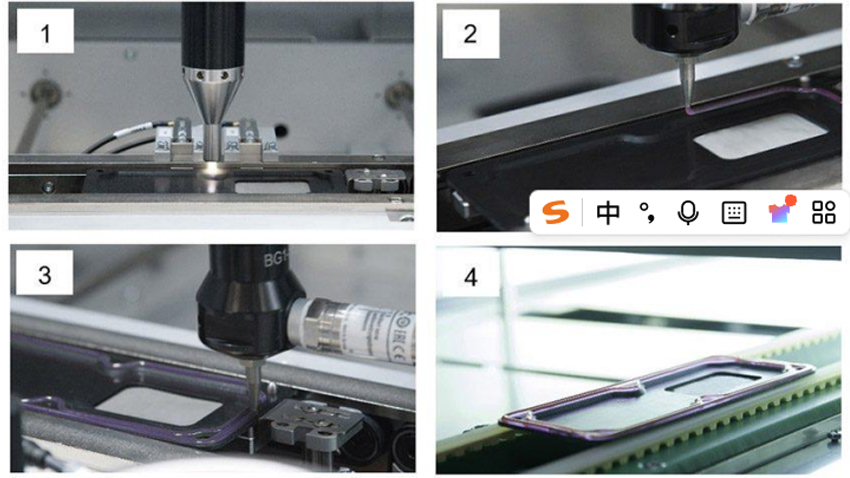
Dispensing and potting machine (controlled adhesive application): a metered amount of adhesive is applied to the target areas of a wire harness, sealing four failure pathways: terminal corrosion caused by moisture and salt-spray ingress, dielectric breakdown and arcing between densely packed pins, mechanical fatigue from vibration, and stress concentration at wire bends. Consistency is ensured by equipment and process parameters, not by manual technique.
Where on a Wire Harness Is Dispensing Most Needed? Five Scenarios, Five Adhesive Families
Different harness geometries and operating conditions call for different fluid application methods. Five common scenarios determine the combination of valve, fixture, and equipment.
| Application Scenario | Primary Failure Risk | Recommended Process | Common Adhesive Systems |
| Connector potting and sealing | Water ingress and creepage between pins | Metered cavity potting + vacuum degassing | Silicone, PU, epoxy |
| Cable joint and contact protection | Oxidation, corrosion, wire breakage | Encapsulation of nodes | PU, epoxy |
| Bonding of rubber boots and seals | Water seepage at feedthroughs, boot detachment | Continuous adhesive application in grooves | Silicone, structural adhesive |
| Cable outlet waterproof sealing | Capillary wicking of water, dust ingress | Circumferential dispensing at the outlet | Silicone, PU, epoxy |
| Wire fixation and strain relief | Bending fatigue, terminal loosening | Targeted bonding (tacking) | Hot-melt adhesive, UV adhesive |
Connector potting is the primary protection point for outdoor and engine-compartment wire harnesses. Potting compound fills the housing cavity and wraps the cable entry, forming a moisture barrier and dielectric isolation; for deep cavities and demanding cure cycles, a two-component (2K) potting system is preferred, while shallow cavities and rework scenarios can use one-component (1K) systems.
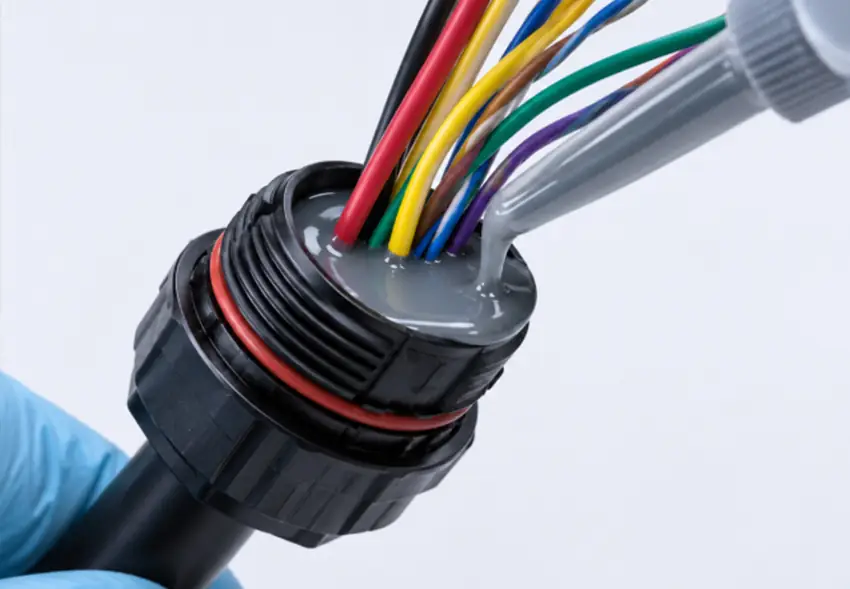
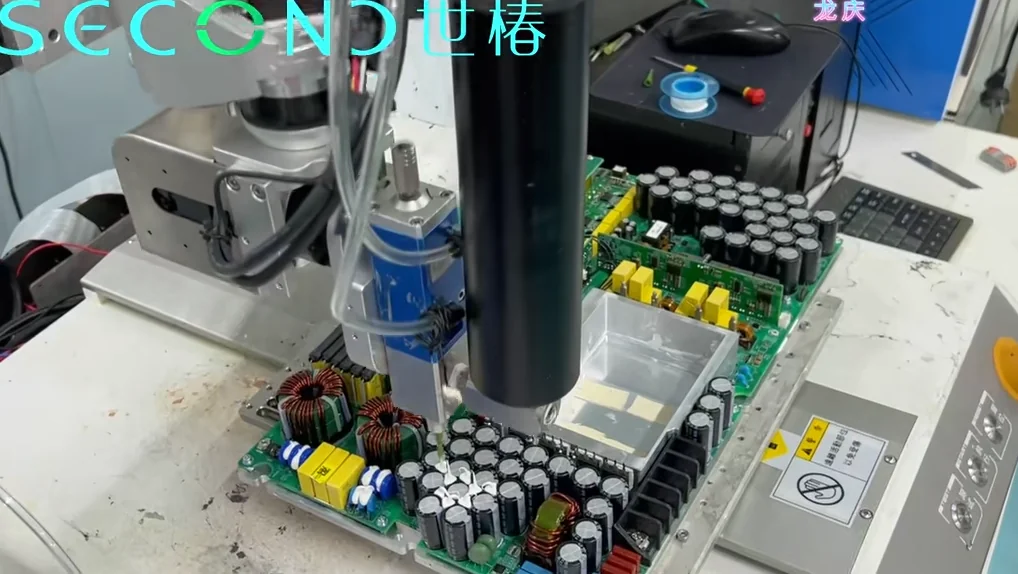
Contact and branch protection targets ultrasonic welds, crimp contacts, and multi-wire branches. A metered potting compound encapsulates exposed nodes, isolating them from oxidation and corrosion to prevent signal attenuation or open circuits; adhesive volume consistency at these nodes directly affects production yield.
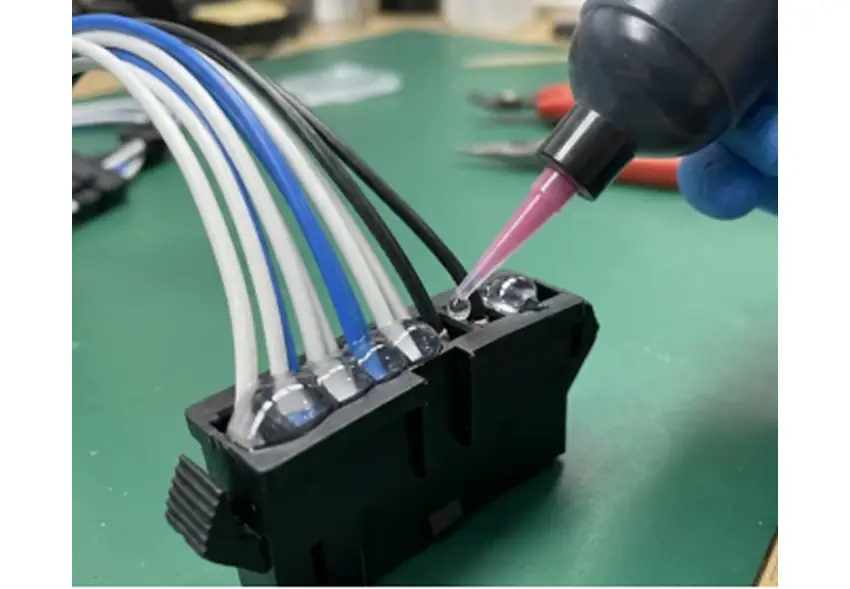
Cable outlet is a main route for water and dust to enter connector backshells in new-energy-vehicle high-voltage harnesses and outdoor telecommunications equipment. Circumferential dispensing forms a continuous sealing barrier, and the adhesive must be compatible with the jacket material (PVC, XLPE, silicone) and the operating temperature range.
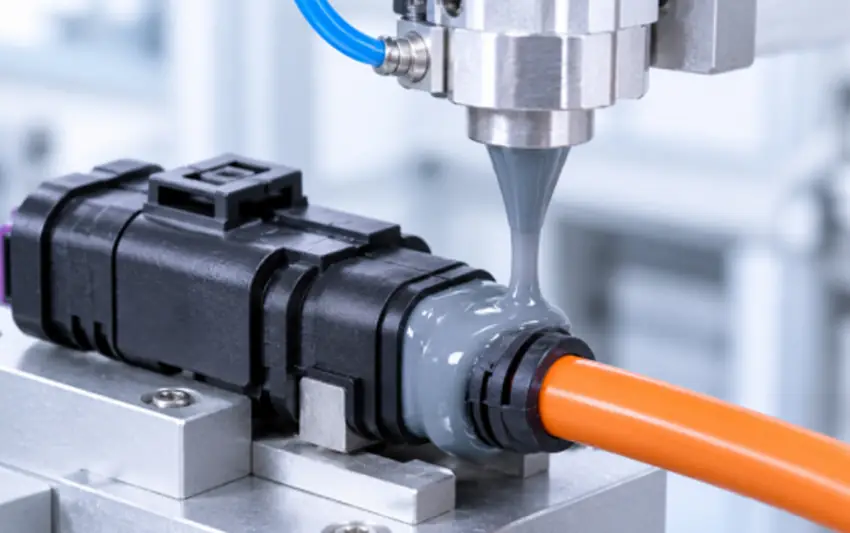
How to Configure Four Types of Potting Equipment? Output and Adhesive System Determine the Machine
Equipment ranges from semi-automatic benchtop stations to fully integrated inline production lines. The core selection variables are throughput, adhesive system, and level of automation.
| Equipment Type | Applicable Stage | Key Configuration | Critical Control Points |
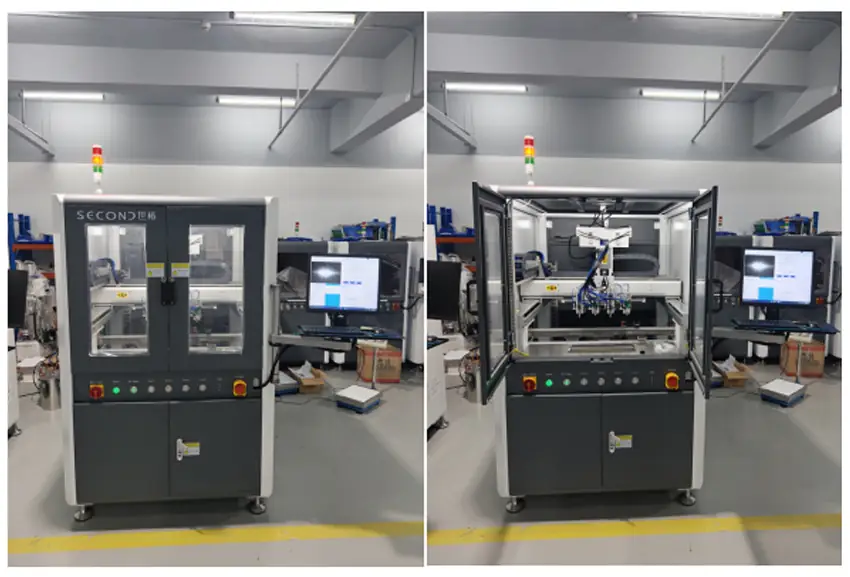
| Benchtop dispensing robot | R&D prototyping, low-volume production, localized sealing of compact connectors | Three-/four-axis platform, teach pendant or PC programming | Repeat positioning accuracy and adhesive dot consistency |
| Two-component metering, mixing, and potting machine | Two-component epoxy, PU, and silicone potting | Gear pump / plunger metering, static or dynamic mixing | Gear pump / plunger metering, static or dynamic mixing |
| Inline dispensing system | High-volume continuous production in automotive and electronics | SMEMA conveyor, CCD vision alignment, laser height measurement | Cycle time, closed-loop flow monitoring, automatic needle tip calibration |
| Custom automation cell | Large, multi-branch, and irregularly shaped wire harnesses | Multi-axis robotic arms, synchronized multi-valve operation, rotary table | Cycle time targets, fixture design, and MES traceability |
Ratio accuracy is the core metric for two-component equipment. Gear-pump or plunger metering typically achieves around ±1% (equipment capability value, subject to project acceptance criteria); filled systems should be equipped with vacuum degassing, barrel heating, and automatic agitation to reduce settling and cure defects.
Which Six Parameters Should You Check When Selecting a Wire Harness Potting Machine?
Translating application requirements into equipment specifications can be done by confirming the following six dimensions one by one, rather than ordering directly from catalogue specifications.
1.Part geometry and accessibility: deep-cavity potting, groove sealing, or dispensing into narrow gaps determines the valve configuration and number of axes.
2.Adhesive system and packaging format: one- or two-component, viscosity, cure profile, and supply from cartridges, pails, or 200L drums.
3.Adhesive volume and flow rate: dispensing weight per part and cycle time requirements determine the metering mechanism specification and dispensing stability.
4.Throughput and automation level: selection among manual benchtop stations, semi-automatic carousels, and fully automatic inline production lines.
5.Positioning accuracy: whether flexible wires or connector housings require CCD vision alignment compensation to locate the dispensing path.
6.Quality and compliance: whether IP67/IP68 verification, bubble-free vacuum potting, and IATF 16949 data traceability are required.
FAQ on Wire Harness Dispensing and Potting
Which Potting Compound Is Used for Automotive Wire Harness Waterproofing?
Silicone and polyurethane (PU) are the most common. Silicone offers high-temperature resistance and flexibility; PU provides strong adhesion and better cost-effectiveness. Choose epoxy resin when structural rigidity and chemical resistance are priorities. Final selection should be based on the operating temperature range and substrate compatibility testing.
How to Avoid Bubbles When Potting Deep-Cavity Connectors?
Three approaches: use a vacuum degassing chamber to remove air from the adhesive before dispensing, optimize the needle entry angle so the compound rises from the cavity bottom, and use a vacuum potting chamber for critical high-voltage parts. The deeper the cavity, the more important it is to validate the venting path and fill time.
Can One Machine Handle Both One-Component and Two-Component Adhesives?
Their feeding and metering hardware differs, so they generally do not share the same dispensing mechanism. A modular gantry platform can be fitted with different valve sets for different adhesive systems, but after switching, adhesive volume calibration and cleaning validation must be repeated.
Can Very Small or High-Density Connectors Be Dispensed Accurately?
Yes. Servo-driven volumetric valves, micro-dispensing needles, dedicated positioning fixtures, and CCD vision alignment enable targeted application within densely populated multi-pin cavities; accuracy should be confirmed with sample trial data.
What Information Should Be Prepared Before Requesting a Quote?
Please provide the 2D/3D drawings or clear photos of the wire harness or connector, the adhesive technical data sheet (TDS), the target adhesive volume or sealing dimensions, and the daily/hourly output and cycle time requirements, so that a tailored configuration recommendation can be provided.
How to Obtain a Wire Harness Potting Solution Evaluation and Sample Trial?
Second Intelligent has been deeply engaged in fluid control for more than 20 years, offering a full line of equipment from benchtop dispensing stations and two-component potting machines to inline dispensing lines and custom automation cells, covering connector potting, contact encapsulation, cable outlet sealing, and strain relief.
Provide product drawings and adhesive TDS for free sample testing and process validation, including recommendations on adhesive compatibility, valve configuration, and cycle time calculation, as well as verification of potting shape, adhesion, and sealing performance on actual parts. Specific equipment parameters and acceptance criteria are subject to the project contract and technical agreement.