Capacitor Fixing Dispensing Application: Detailed Explanation of Five-Axis Dispensing Machine with RTV Adhesive Solution:
In the electronics manufacturing industry, capacitors, as high-performance components, are highly susceptible to vibration during transportation, installation, and operation, which can even lead to pin breakage. To address this issue, a five-axis dispensing machine combined with RTV adhesive is gradually becoming a standard process in the automotive electronics, power module, and home appliance industries. This article will delve into the technical advantages and practical value of this combination
Ⅰ.Why is a 5-axis + RTV dispensing system needed for capacitor mounting?
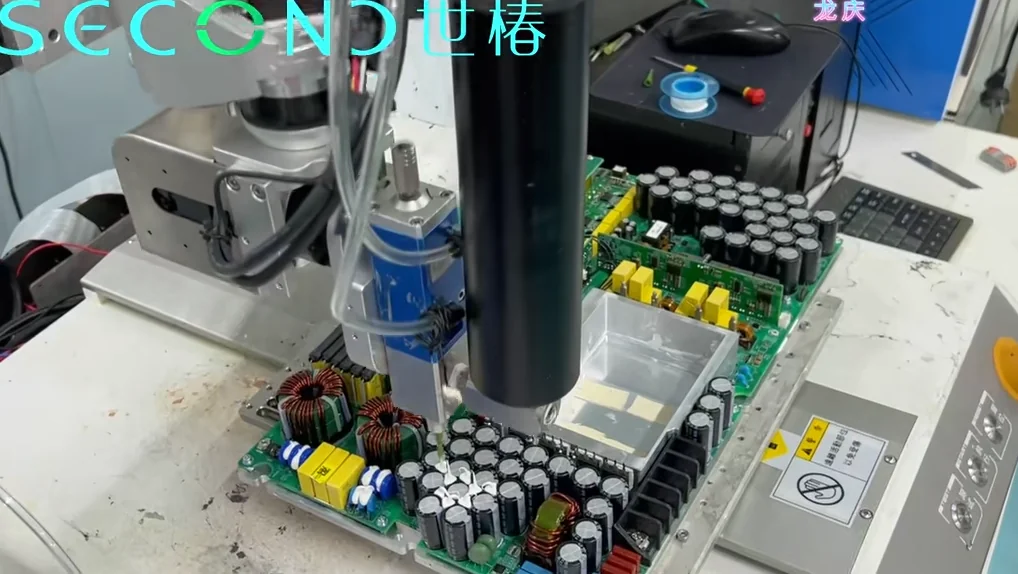
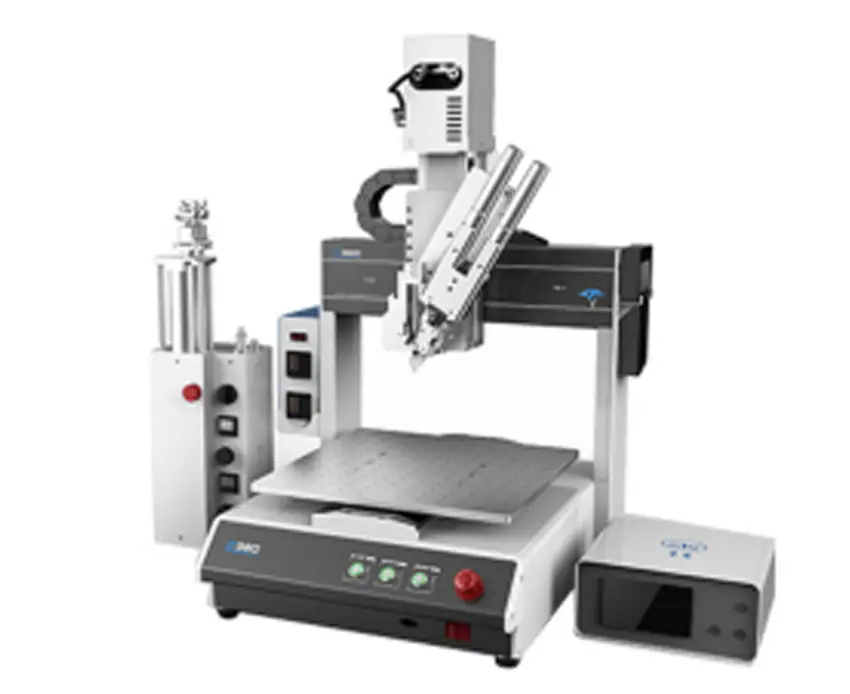
Traditional 3-axis dispensing machines can only dispense adhesive vertically, which is often insufficient for reinforcing the bottom or sides of capacitors. In actual manufacturing processes, to strengthen the adhesion between components and the PCB substrate, vertical dispensing is far less effective than inclined dispensing. Typically, the dispensing needle needs to be tilted at 20° to 40° to accurately deliver the adhesive to the base.
RTV silicone dispensing (single-component room temperature vulcanizing silicone rubber) is solvent-free, non-corrosive, resistant to high and low temperatures, and has excellent impact and vibration resistance. After curing, it forms an elastomer that effectively absorbs vibration stress. However, RTV adhesive has a high viscosity (tens of thousands to hundreds of thousands of cps), and the area around capacitors is often densely packed with components, leaving limited space. A 5-axis dispensing machine, with its X, Y, and Z linear axes working in conjunction with the A and C rotary axes, can move the dispensing valve to approach the side of the capacitor from any angle, perfectly solving the problems of “not being able to reach” and “difficult angles.”
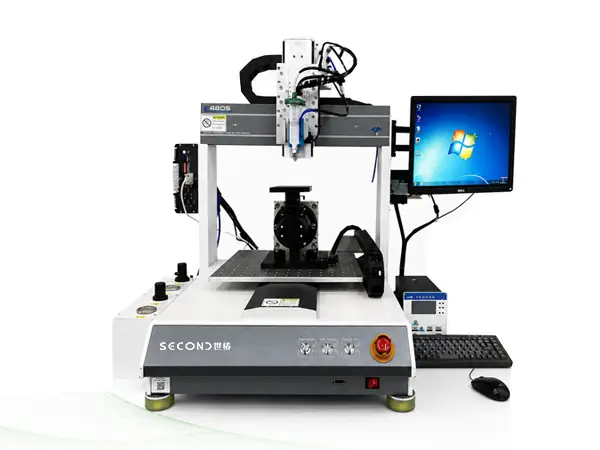
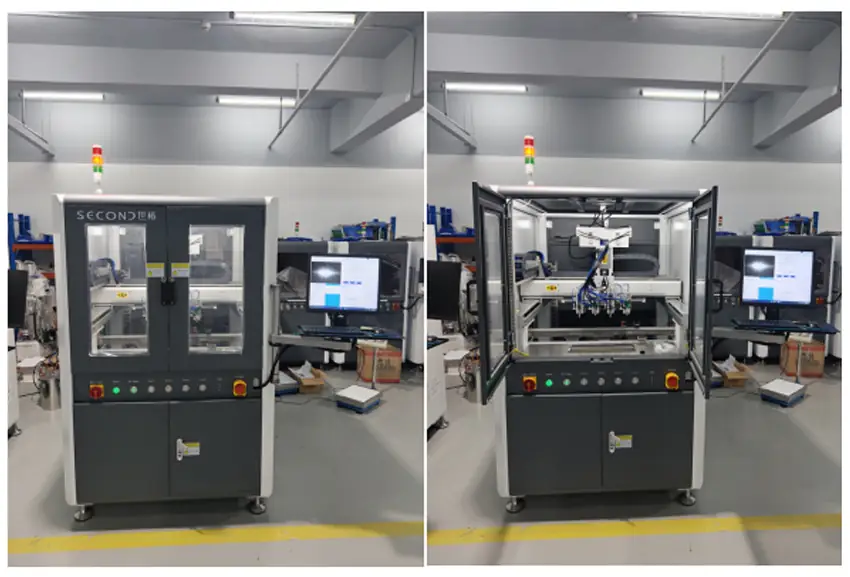
Desktop glue dispensing machine robot SEC-E480SV with CCD visual
Second Intelligent Desktop Glue Dispensing Machine SEC-E480SV adopts high-precision servo motor + grinding ball screw, which can ensure accuracy while having higher cost performance. It is also equipped with CCD visual height measurement, which makes programming more efficient and more accurate. It is an aviation aluminum alloy die-casting one-piece design desktop glue dispensing machine, which is more solid, more stable, with double rotating stations, small and flexible.
Ⅱ.Core Advantages of the Five-Axis Solution for Capacitor Fixation
1.Multi-Angle Tilt Dispensing, Eliminating Dead Angles in Reinforcement
The end axis of the five-axis dispensing equipment can achieve tilting from 0 to 60° or even larger and 360° rotation. Facing capacitors of different heights and gaps, the equipment can adjust its posture in real time, avoiding interference from adjacent tall components, and precisely applying RTV adhesive to the junction of the capacitor base and the PCB, forming a solid “adhesive corner” support.
2.Intelligent Vision and Height Detection, Addressing Component Deviations
After reflow or transfer, the position of component capacitors often has slight deviations. Five-axis dispensing systems typically incorporate CCD vision positioning and laser height detection systems. The vision system automatically identifies the actual position of the capacitor and corrects its trajectory, while laser height detection ensures that the probe maintains a safe distance from the board surface or component sidewalls even when tilted, avoiding collisions or uneven adhesive application.
3.Adhesive Amount and Cut-off Control, Improving Consistency
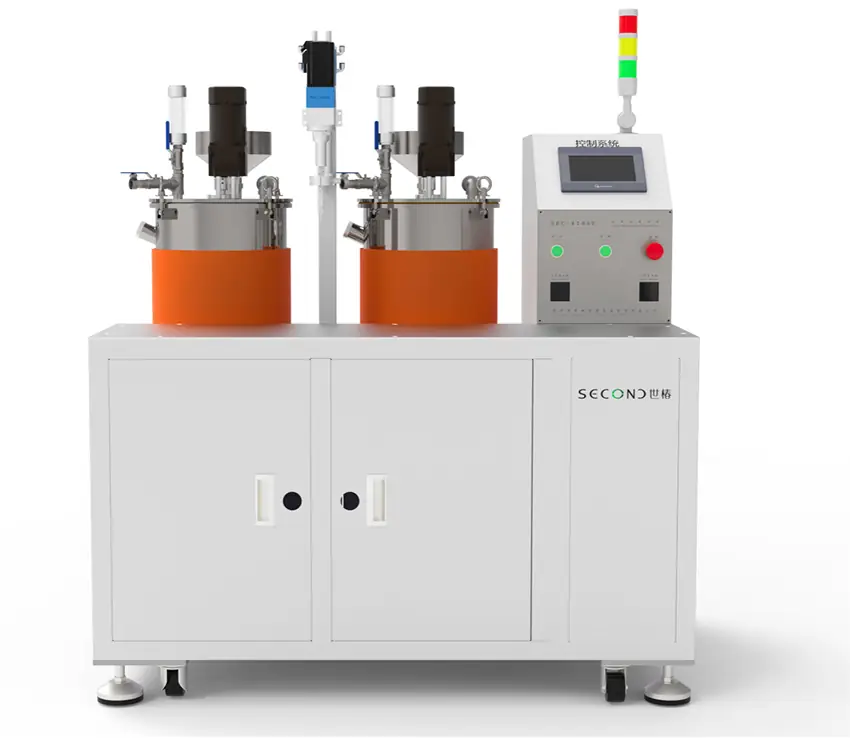
RTV adhesive dispensing machine has good thixotropic properties, but improper control during tilted dispensing can easily lead to stringing or adhesive tailing. The high-end five-axis system incorporates functions such as pre-opening/closing of adhesive, rewinding, and filament breakage, and supports real-time adjustment of adhesive dispensing based on movement speed. This means that the amount of adhesive will automatically decrease when slowly routing in areas with dense capacitors, and will quickly stop dispensing when rapidly crossing empty spaces, ensuring that the amount of adhesive used to reinforce each capacitor is consistent and the appearance is neat.
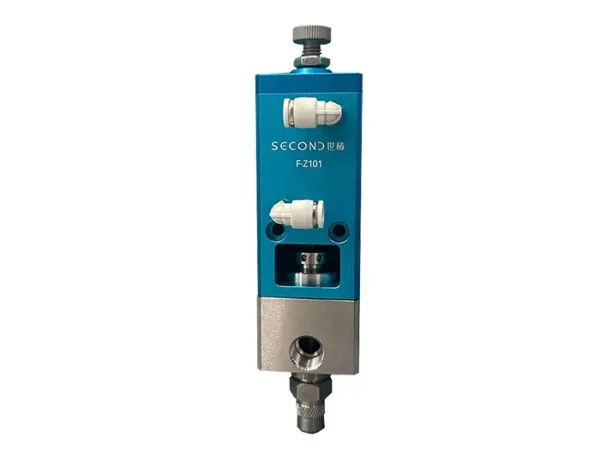
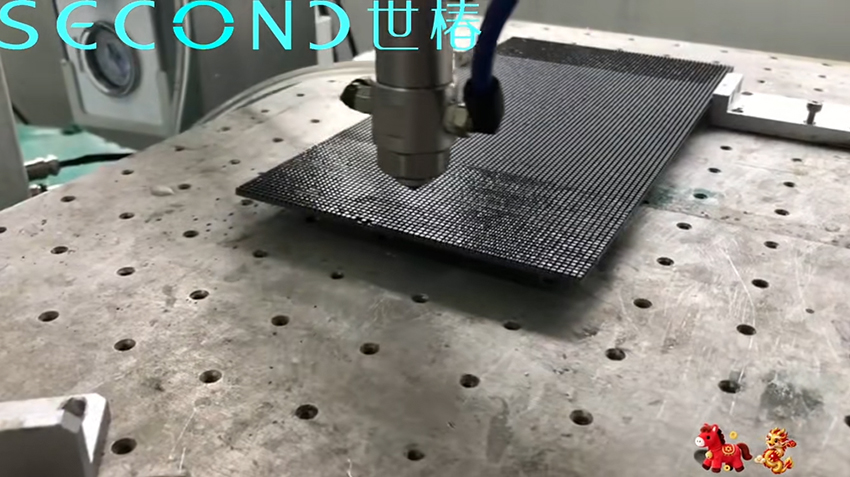
Stainless steel Needle glue dispensing Valve F-Z101
III. Key Process Considerations for Implementing a Five-Axis Dispensing Machine with RTV Adhesive?
1.Dispensing Location Selection
For capacitor fixing, one or a combination of the following methods are typically used:
● Bottom Filling/Damaging:A ring of adhesive is applied around the bottom edge of the capacitor. After curing, this forms a support ring, limiting component movement during vibration.
● Lead Root Reinforcement:A small dot of adhesive is applied at the junction of each lead and pad, directly reinforcing the weakest solder joint area and preventing fatigue cracking at the lead root.
● Side Assistance: For capacitors with a high center of gravity, adhesive can be applied to the side to connect to adjacent board surfaces, forming a second layer of restraint.
2.Adhesive Quantity and Glue Line Control
● RTV adhesive viscosity is typically between tens of thousands and hundreds of thousands of cps, classifying it as a high-viscosity paste.** Excessive adhesive quantity will overflow onto adjacent pads or components, causing interference; insufficient quantity will fail to provide support. Five-axis dispensing systems usually require adhesive quantity weighing or flow monitoring to ensure consistency in each dispensing cycle. When dispensing at an angle, the dispensing speed must be matched with the five-axis motion speed to avoid glue buildup or breakage during speed changes.
3.Attitude and Path Planning
The advantage of five-axis dispensing machine lies in its controllable attitude, but this also increases programming complexity. For short-distance, multi-angle dispensing such as capacitor fixing, the path typically does not require complex spatial curves, but rather discrete “points” or short line segments. It is important to note that when dispensing at an angle, the relative angle and distance between the needle and the component surface must be precisely controlled; otherwise, collisions or glue dragging may occur.
Ⅳ.Common Problems and Solutions?
Advantages of five axes | Possible reasons | countermeasures |
The colloid detaches after curing. | Poor substrate adhesion, missing primer | Confirm the compatibility between the adhesive and the capacitor casing/PCB; add primer if necessary. |
Glue overflow onto adjacent components | Excessive glue content or excessive glue fluidity | Reduce the dispensing rate and check the thixotropy of the adhesive; increase the adhesive viscosity appropriately when dispensing at an angle. |
Insufficient support | Insufficient number of support points or insufficient amount of adhesive | Depending on the capacitor’s weight and center of gravity, add bottom support points or increase the amount of adhesive applied at a single point. |
Incomplete internal curing | Excessive adhesive layer thickness and slow room temperature curing | Control the thickness of each application of adhesive, or switch to a heat-curing accelerated curing method. |
RFQ:
Q1: Can the 5-axis model achieve tilting/lateral approach of the dispensing head to the bottom and lead roots of capacitors?
What are the travel, rotation angle range, and repeatability of each axis?
A: Please answer with the 5-axis linkage configuration (X/Y/Z + dual rotary axes), the rotation axis angle range (e.g., ±90° or ±180°), and the repeatability (e.g., ±0.02mm/±0.05°). Also, explain the method for controlling the minimum safe distance between the needle and the component surface during tilting approach.
Q2: For high-viscosity RTV silicone (approximately 50,000–300,000 cps), is a screw pump or a plunger pump recommended? How is the consistency of dispensing volume monitored?
A: Please answer with the pump selection criteria (screw pumps or plunger pumps are generally recommended for high-viscosity pastes), dispensing volume repeatability data (e.g., ±2%–5%), and the configuration scheme and calibration cycle for weighing monitoring or flow monitoring.
Q3: Is visual positioning and laser height detection standard?
Can it compensate for capacitor incoming material deviations and prevent collisions during tilting approach? A: The response should include visual positioning accuracy, laser height detection response time, compensation logic (detecting height first and then tilting to approach), and collision protection mechanisms (such as force-controlled retreat or safe height strategy).