Configurations
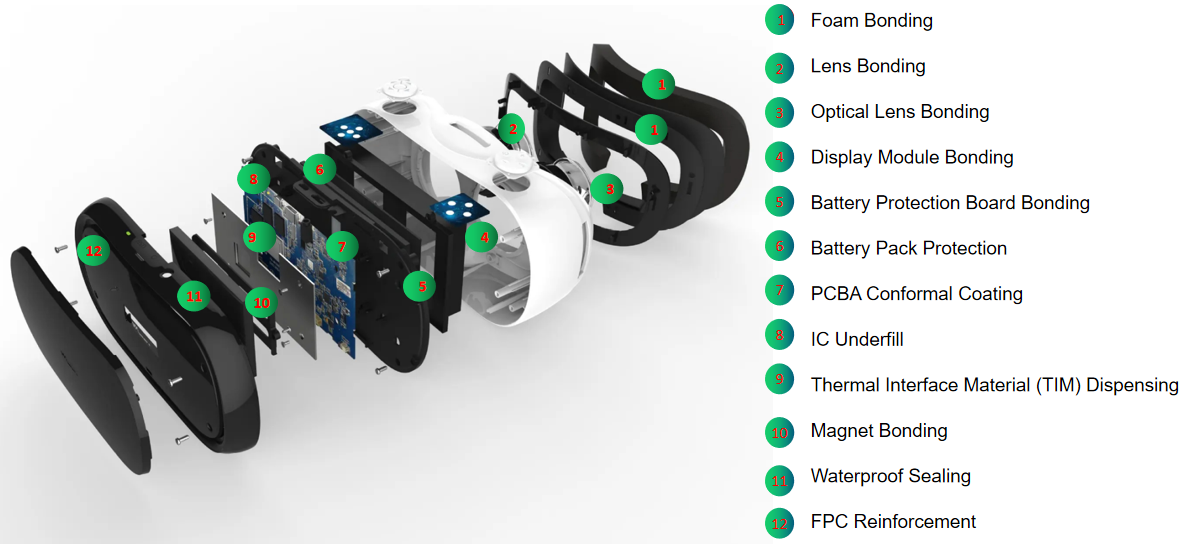
In industrial manufacturing, two-component acrylic AB adhesive (commonly known as “red-green adhesive” or structural adhesive) is widely used in automotive structural parts, battery PACK assemblies, filter sealing, electronic potting, industrial assembly and hardware & electronics industries. It features fast curing, high bonding strength, excellent impact resistance and good tolerance that does not require strict degreasing.
However, this “high-performance adhesive” can be temperamental during dispensing: it is highly corrosive, cures extremely quickly (with an open time of only 3-15 minutes), and is highly sensitive to mixing ratios.
Many enterprises often overlook metering accuracy, select inappropriate mixing methods, or use mismatched core components when choosing dispensing equipment for two-component acrylic AB adhesives. This leads to issues such as inconsistent adhesive ratios, uneven mixing, and unstable dispensing, which in turn cause bonding failure, adhesive overflow, abnormal curing, and other problems. article will conduct an in-depth breakdown of core configurations and key selection criteria.
I. Pre-Selection Prerequisite: Clarify the Properties of Acrylic AB Adhesive
The properties of two-component acrylic AB adhesive dispensing directly determine the selection direction of the metering system, mixing method and core components. Only by aligning with the adhesive properties can we fundamentally avoid incompatibility between the equipment and the adhesive, which is the basic premise for selection:
1.Corrosiveness: Acrylic monomers corrode or cause swelling in ordinary metals (such as copper, aluminum, iron) and some plastics (such as PC, ABS). Therefore, the equipment flow channels must be made of PTFE or 316L stainless steel.
2.Fast Curing: The open time is extremely short. The equipment must support an instant cut-off function to prevent dripping that may clog the needle.
3.Volumetric Mixing: The vast majority of acrylic AB adhesives have a volume ratio of 10:1, with a few at 1:1 or 2:1. A 1% deviation in the ratio may reduce bonding strength by 50%
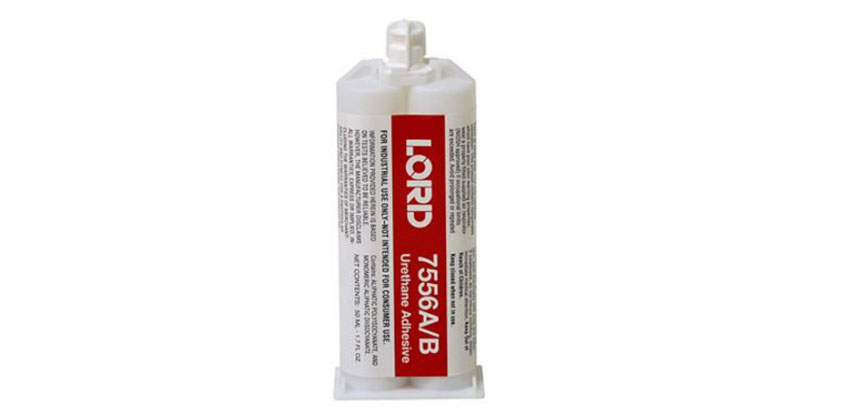
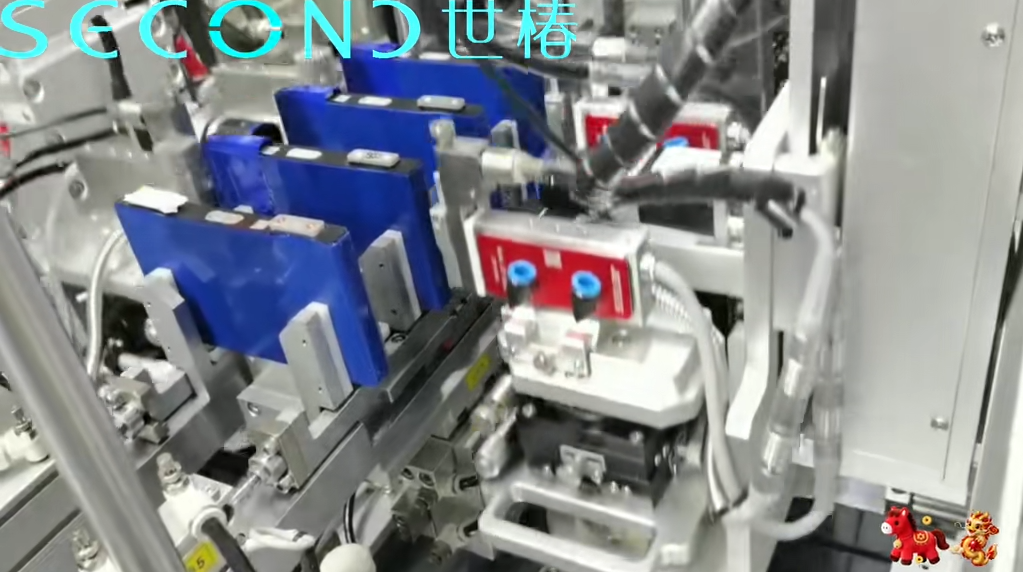
Figure 1: Acrylic AB Adhesive
II. Core Configurations of Dispensing Equipment for Two-Component Acrylic AB Adhesive: Indispensable
The core configurations of the dispensing equipment directly determine dispensing accuracy, mixing effect and production efficiency. Focus on the following 5 key components, which are the core of the selection process:
1. Adhesive Supply System: Precise Proportioning as the Core, Stable Supply as the Foundation
The adhesive supply system is the “heart” of the two-component dispensing equipment. Its core function is to accurately deliver Component A and Component B adhesives, control the mixing ratio and flow rate, and avoid ratio deviations and supply interruptions.
● Pump Selection: Select the appropriate pump based on adhesive viscosity, the key to stable supply. For low-viscosity two-component acrylic AB adhesive (≤5,000 mPa·s), precision screw pumps are preferred—they offer precise flow, uniform dispensing, and are suitable for micro-dispensing. For medium-to-high viscosity adhesives (5,000–50,000 mPa·s), plate pumps or piston pumps are used. These adapt to 5L/20L drum adhesives, deliver stable continuous supply, and prevent adhesive breakage or overflow. For high-viscosity, thixotropic adhesives, a piston pump with a pressurization function is recommended to ensure smooth adhesive delivery.
● Dual Independent Pump Design: A “dual independent adhesive supply” structure is mandatory, with separate pumps controlling Component A and Component B. This eliminates mutual interference and ensures precise proportioning. The pumps must also feature flow adjustment to flexibly adjust the delivery volume of A and B adhesives for different ratios, with a proportioning error within ±1% to meet the requirements of various AB adhesive models.
Adhesive Drum & Piping: Adhesive drums are recommended to be made of PP or 316 stainless steel for strong corrosion resistance and to prevent chemical reactions between the adhesive and the drum. Piping should use PTFE or 316 stainless steel with a smooth inner wall to reduce adhesive residue and corrosion. Keep piping as short as possible to minimize adhesive residence time and avoid premature curing.
2. Mixing System: Uniform Mixing Determines Curing and Bonding Effect
The mixing system is the critical core of two-component acrylic AB adhesive dispensing. The mixing effect directly affects adhesive curing quality and bonding strength. Select based on adhesive viscosity and production requirements:
● Static Mixing Tube: Suitable for low-viscosity, free-flowing two-component acrylic AB adhesive. It has a simple structure and low cost, achieving thorough mixing of A and B adhesives via internal spiral blades without power drive. Ideal for micro-volume, small-batch dispensing. When selecting, match the tube length and number of spiral blades to adhesive viscosity and output—higher viscosity requires longer tubes and more blades.
● Dynamic Mixing Valve: Suitable for medium-to-high viscosity, thixotropic two-component acrylic AB adhesive. A motor drives high-speed rotation of mixing blades to force-mix A and B adhesives, delivering higher mixing uniformity and eliminating dead zones. Especially suitable for high-volume, continuous production scenarios. Can be paired with a static mixing tube for enhanced mixing results.
● Anti-Curing Design: The mixing system must support quick disassembly and cleaning. Mixing tubes and valves can be rapidly removed and cleaned with a dedicated solvent to prevent curing and clogging during downtime. High-end models feature an automatic cleaning system that injects cleaning solvent into piping and mixing components after shutdown without manual intervention, boosting efficiency and extending equipment life.
3. Dispensing Valve: Match Adhesive Properties to Eliminate Stringing and Overflow
The dispensing valve controls the timing and volume of adhesive output. Select based on adhesive viscosity and dispensing requirements to avoid stringing, adhesive breakage, overflow and other issues:
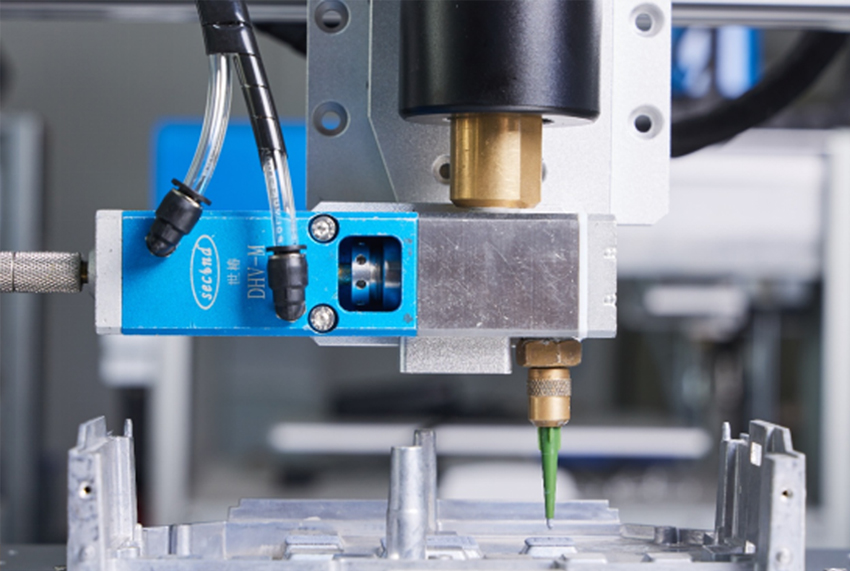
● Retraction Dispensing Valve: The preferred choice, especially for medium-to-high viscosity two-component acrylic AB adhesive. At the end of dispensing, the valve stem retracts adhesive from the needle, eliminating stringing, tailing and overflow, ensuring dispensing accuracy. Ideal for precision dispensing scenarios (eg, electronic component bonding).
● Needle Dispensing Valve: Suitable for low-viscosity two-component acrylic AB adhesive. It features sensitive switching and fast dispensing speed, ideal for high-volume, rapid dispensing scenarios. Must be paired with a negative pressure retraction device to prevent dripping of low-viscosity adhesive.
● Corrosion-Resistant Design: The valve core and seat must be made of PTFE or 316 stainless steel to resist adhesive corrosion, prevent valve core jamming and leakage, reduce residue, and facilitate cleaning.
4. Motion Platform: Adapt to Production Scenarios to Boost Efficiency
The motion platform determines dispensing flexibility and production efficiency. Select based on product size, production batch and operation method to ensure accurate and efficient dispensing:
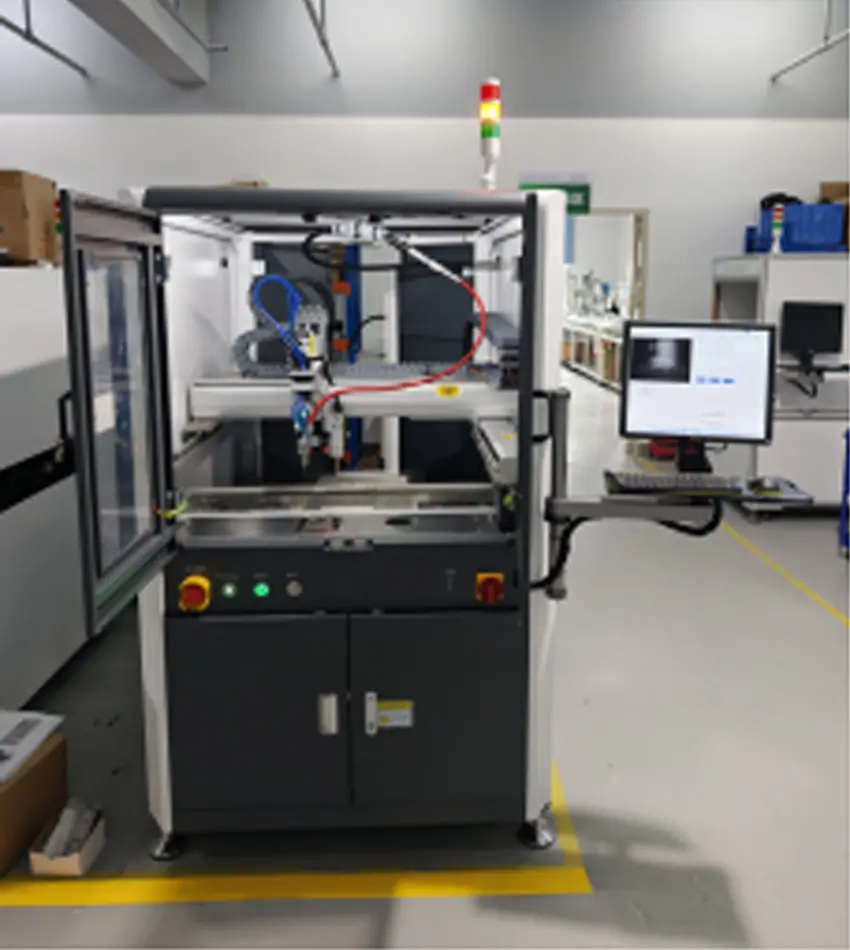
● Benchtop 3-Axis Dispenser: Suitable for small-batch, small-sized products (eg, electronic components, small hardware parts). Compact, flexible to operate and cost-effective. Supports point, line, surface, arc and other dispensing paths, adapting to laboratory and small-batch production scenarios.
● Floor-Standing Gantry Dispenser: Suitable for large-sized products (eg, automotive parts, new energy battery enclosures). Long travel, high load capacity. Can be equipped with multiple dispensing heads for simultaneous multi-station dispensing, boosting efficiency for medium-to-large batch production.
● In-Line Automatic Dispenser: Suitable for assembly line continuous production. Connects to production lines for automatic loading/unloading, dispensing and inspection, enabling unmanned operation. Significantly improves efficiency and reduces labor costs for mass, standardized production (eg, electronic modules, medical device components).
● Accuracy Requirement: The motion platform must have a repeat positioning accuracy of at least ±0.02 mm to ensure precise dispensing positions and avoid defects from positioning errors, especially for precision products.
5. Auxiliary Configurations: Enhance Stability and Reduce Maintenance Costs
While not core components, auxiliary configurations greatly improve dispensing stability, extend equipment life and reduce maintenance costs—they cannot be overlooked during selection:
● Adhesive Temperature Control Module: The viscosity of two-component acrylic AB adhesive is highly temperature-dependent. Temperature fluctuations cause unstable output and ratio deviations. A constant temperature control module maintains adhesive temperature within an optimal range (typically 20–25°C), ensuring consistent dispensing.
● Negative Pressure Retraction Device: Paired with dispensing valves, especially for low-viscosity adhesive, effectively preventing dripping and stringing to enhance accuracy. Assists retraction for high-viscosity adhesive to avoid residual curing in the needle.
● Liquid Level Detection Device: Real-time monitoring of A and B adhesive drum levels, with automatic alarms for low adhesive levels. Prevents supply interruptions from empty drums and ensures continuous production.
● PLC Control System:Equipped with a high-definition touchscreen for intuitive setting of dispensing parameters (ratio, flow rate, speed, path). Supports parameter saving and recall for easy operation. Enables fault alarms and automatic shutdown for simplified maintenance.
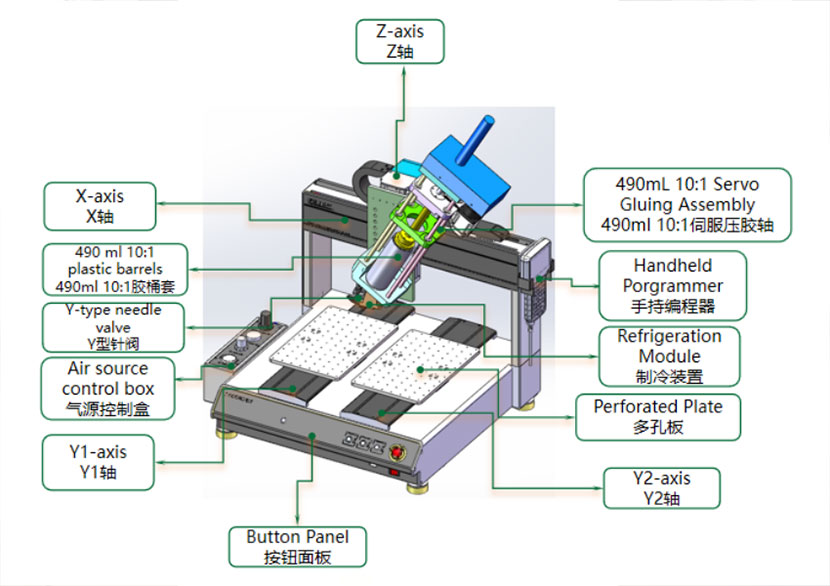
Figure 2: Second Intelligent Acrylic AB Adhesive Benchtop Dispenser Machine Configuration Reference
III. Key Selection Criteria for Two-Component Acrylic AB Adhesive Dispensing Equipment: Avoid These Pitfalls
1. Do Not Blindly Pursue “High-End”—Align with Production Needs
The core of selection is “adaptation,” not high-end equipment. For small-batch, precision dispensing, a benchtop 3-axis dispenser suffices—no need for expensive floor-standing or in-line models to avoid resource waste. Opt for in-line automatic equipment only for mass assembly line production. Select pumps and mixing systems based on adhesive ratio and viscosity to avoid overengineering or incompatibility.
2. Prioritize “Proportioning Accuracy” Over Price
The core requirement for two-component acrylic AB adhesive is precise proportioning. Large ratio deviations, even with low-cost equipment, lead to low product yield and higher costs. Prioritize equipment with a proportioning accuracy of ≤±1%, then consider price—avoid choosing low-precision equipment for cost savings, which ultimately proves counterproductive.
3. Emphasize “Corrosion-Resistant Design” to Extend Equipment Life
The corrosiveness of two-component acrylic AB adhesive rapidly damages ordinary equipment components, increasing maintenance costs. Confirm that all adhesive-contacting parts (drums, piping, dispensing valves, mixing components) are made of corrosion-resistant materials (PP, PTFE, 316 stainless steel) to prevent corrosion and ensure long-term performance.
4. Consider “Post-Maintenance” to Reduce Operational Costs
Easy post-maintenance directly lowers operational costs. Select equipment with a simple, easily disassembled and cleaned structure—especially mixing systems and dispensing valves for convenient daily maintenance. Verify the manufacturer provides comprehensive after-sales service (equipment commissioning, repairs, parts supply) to avoid production disruptions from delayed fault resolution.
IV. Scenario-Based Selection Guide: Precise Matching for Specific Needs
● Precision Bonding of Electronic Components (Chips, Sensors, Connectors): Benchtop 3-axis dispenser + precision screw pump + retraction dispensing valve + static mixing tube. Proportioning accuracy: ±0.5%, repeat positioning accuracy: ±0.02 mm. Ideal for micro-volume, precision dispensing.
● Structural Bonding of Automotive Parts (Lamps, Bumpers, Interior Parts): Floor-standing gantry dispenser + plate pump + dynamic mixing valve + automatic cleaning system. Adapts to high-volume, continuous dispensing with multiple heads for enhanced efficiency.
● Bonding of New Energy Components (Battery Enclosures, Photovoltaic Modules): In-line automatic dispenser + dual piston pump + dynamic mixing valve + constant temperature module. Connects to production lines for unmanned operation, ensuring consistent dispensing and high efficiency.
● Mass Bonding of Hardware & Plastic Parts (Hardware Brackets, Plastic Housings): Benchtop or floor-standing dispenser + piston pump + retraction dispensing valve. Adapts to medium-to-high viscosity AB adhesive with easy operation for medium-batch production.
Second Intelligent Two-Component Acrylic Seal Groove Dispensing
V. Summary
Selecting dispensing equipment for two-component acrylic AB adhesive hinges on prioritizing core needs and optimizing details —centered on a metering system for precise proportioning, a mixing method for uniform blending, paired with suitable dispensing valves, motion platforms and auxiliary systems. Align with the adhesive’s viscosity, ratio and corrosiveness, avoid selection pitfalls, and achieve efficient, precise and stable dispensing.
The core of selection is not pursuing high-end features, but adaptation—matching adhesive properties, production batch and product accuracy requirements. This not only leverages the bonding advantages of two-component acrylic AB adhesive, but also reduces equipment investment and maintenance costs, improving product yield and empowering enterprise production.