I. Industry Background: The Energy Storage Sector is Undergoing Profound Transformation
China’s energy storage battery industry is currently accelerating its transition from “scale expansion” toward a “high-quality, high-consistency, traceable” digital and intelligent phase. The industry is facing three core changes:
Explosive Growth in Energy Storage Demand: Global energy storage installation demand is projected at approximately 198GWh in 2024, with an estimated 44% growth to 285GWh in 2025 and 32% growth to 377GWh in 2026. All 314Ah cell production lines of China’s TOP15 energy storage battery enterprises are running at full capacity, with order backlogs generally extending through 2026.
High Capacity Utilization Rates: Capacity utilization rates for first-tier and second-tier manufacturers have risen to 70–80%, while third-tier manufacturers have also reached over 65%. CATL’s total production schedule for 2026 is expected to reach 1.1TWh, corresponding to an estimated 400GWh+ of new effective capacity.
Policy-Driven Digital and Intelligent Transformation: The mandatory requirements for full-lifecycle data traceability of batteries under the EU’s New Battery Regulations have taken effect. Domestically, the Implementation Plan for Digital Transformation of the Automotive Industry and the “15th Five-Year Plan” related industrial policies are advancing in depth, creating a window of opportunity for domestic substitution of key process equipment.
Supplier | Core Strengths | Main Products | Customer Coverage |
Supplier A | Mid-to-late stage equipment (wrapping, filling, canning, helium leak testing, etc.) | Wrapping equipment, hot-pressing equipment, filling equipment | CATL, Sunwoda, REPT, EVE Energy, Hithium, etc. |
Supplier B | #1 market share in stacking machines (17.43%) | Stacking machines, winding machines, filling machines | CATL, BYD, SVOLT, Panasonic |
Supplier C | Flexible PACK lines | Prismatic battery energy storage PACK lines | Home energy storage, communication base stations, wind/solar power |
Supplier D | Laser welding | Laser welding + dispensing/sealing integrated solutions | Power batteries, energy storage |
II. Current Status of Automated Equipment Production in Leading Energy Storage Battery Manufacturers
2.1 Landscape of Major Equipment Suppliers
The primary suppliers of automation equipment for leading energy storage battery enterprises include:
2.2 Key Trends in PACK Assembly Automation
(1) Upgraded Fastening Processes
Battery PACKs require a large number of screws around the perimeter, with high takt time requirements. Leading enterprises have widely adopted multi-axis synchronous fastening systems—Leetx’s three-axis synchronous screw feeding and fastening system has been deployed in volume at leading battery enterprises, achieving synchronous tightening of three bolts and increasing single-station takt time by over 50%.
(2) Flexible Production Line Upgrades
In response to the demand for large-capacity high-voltage energy storage systems, energy storage companies have increased the number of series-connected cells from 52S to 104S. Dispensing processes now employ 3D path technology, and adhesive supply systems have been upgraded to plunger-type pressure plate pumps to eliminate secondary contamination at the source. Hymson has launched flexible PACK lines compatible with 50AH-280AH cells, achieving equipment efficiency of 12-16 PPM and a first-pass yield of 99.3%.
III. Current Status of Dispensing/Potting Processes in Energy Storage Batteries
3.1 Mainstream Process Requirements
The requirements for dispensing/potting processes in energy storage batteries are increasing significantly. According to industry technical literature, module production typically uses two types of adhesives: thermal conductive adhesives (primarily for thermal management) and structural adhesives (primarily for bonding strength).
Process Step | Key Technical Requirements | Current Status and Trends |
Thermal/Structural Adhesive Coating | Adhesive layer thickness 0.7-1.2mm, curing time, bond strength | Two-component A/B adhesives mixed via pump system before coating |
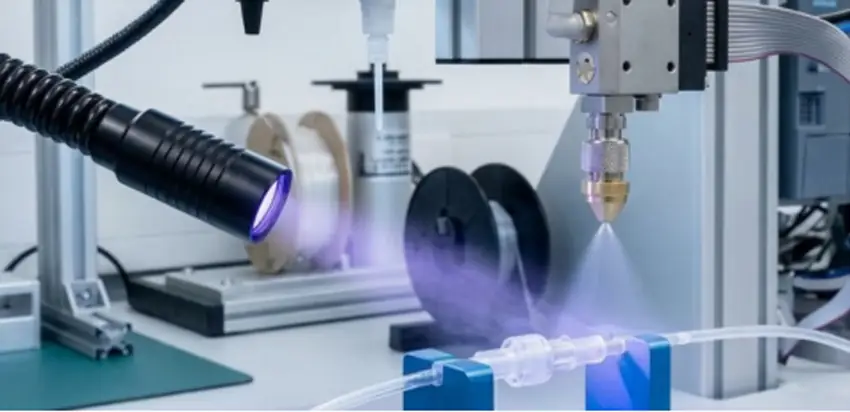
CCS Nickel Tab UV Dispensing | Securing wire harnesses, preventing welding oxidation | UV curing, quality traceable |
Narrow-Gap Potting | Precise application in 3mm gaps | Vacuum degassing, zero dripping, zero stringing |
Adhesive Supply System | Filler anti-settling, inline degassing | 20L agitated supply system + intermediate vacuum degassing |
Typical Process Flow (using Narada Power as an example):
In Narada Power’s energy storage system integration workshop, cells undergo wrapping, stacking, and insertion into enclosures before entering the critical adhesive application stage: case loading → dedicated fixture installation → leak testing → automatic entry into dispensing equipment after bracket installation → module insertion after automatic dispensing machine. Additionally, after module welding is completed, UV adhesive dispensing is performed at the CCS nickel tab welding positions, followed by UV curing dispensing.
3.2 Core Pain Points and Solutions
Pain Point 1: Difficulties in High-Filler Adhesive Supply
Thermal conductive potting compounds contain large amounts of fillers such as alumina, which are prone to settling and clogging. Solution: Employ 20L agitated supply systems with intermediate vacuum degassing. Screw metering ensures linear, pulse-free flow, while end-of-line suction valves achieve zero dripping and zero stringing for precise application in 3mm narrow gaps.
Pain Point 2: Dispensing Quality Consistency
In energy storage product dispensing processes, adhesive leakage and stringing directly impact product yield. Solution: Adopt 3D path dispensing technology and upgrade the adhesive supply system to plunger-type pressure plate pumps to eliminate secondary contamination at the source.
Pain Point 3: Production Line Data Traceability Requirements
The EU’s New Battery Regulations mandate full-lifecycle data traceability for batteries. Solution: Integrate control systems with MES (Manufacturing Execution System) to achieve a complete closed-loop process data traceability. Centron’s CS3000 intelligent modular control system has already achieved “plug-and-play” interoperability of standardized functional units including supply, metering, vision, and central control.
IV. Second Intelligent’s Market Positioning and Product Configuration
4.1 Second Intelligent’s Existing Energy Storage Business Footprint
Second Intelligentalready has dedicated product lines in the new energy/energy storage sector:
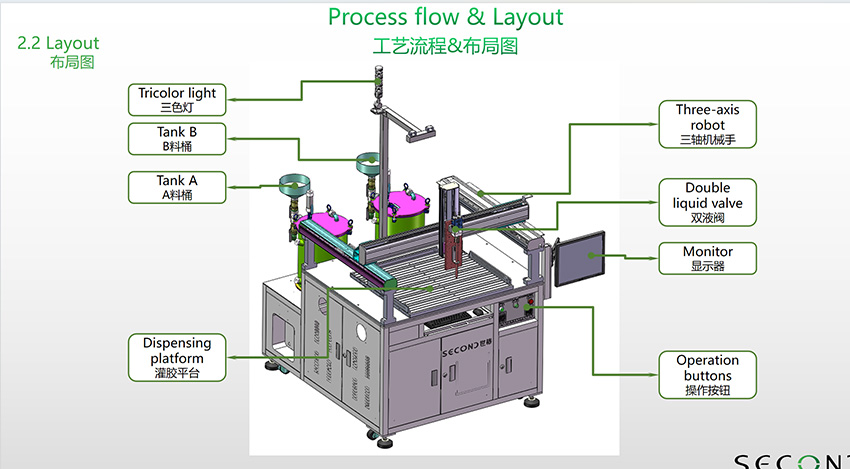
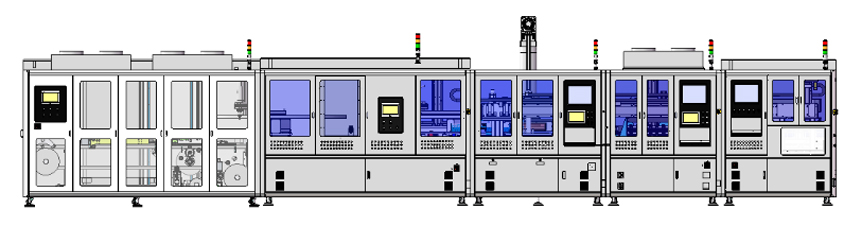
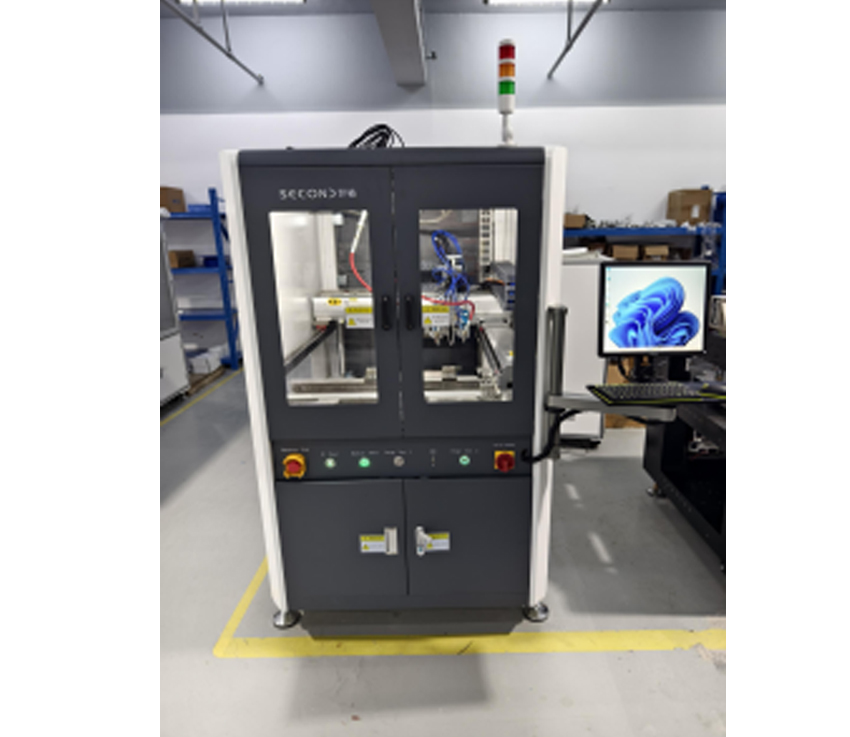
(1) Power/Energy Storage Battery CCS Dispensing and Curing Line
Second Intelligent has launched a dedicated dispensing and curing line for CCS systems in power batteries and energy storage batteries, with the following core specifications:
Functional Module | Specific Configuration |
Compatibility | Compatible with product sizes 500-2000mm |
Vision System | Vision positioning, product deformation correction, automatic needle calibration |
Quality Control | Automatic adhesive volume inspection, dispensing effect inspection, adhesive barcode anti-error scanning |
Adhesive Supply System | Liquid level detection and alarm, adhesive pipeline explosion protection |
Automation | Automatic flipping, automatic curing |
Traceability | Standard MES system integration for product traceability |
Modular Design: Each workstation can operate independently as a standalone unit or be connected to form a fully automatic production line. It is compatible with multiple adhesive supply systems, supporting CIPG, FIPG, and thermal grease dispensing processes.
(2) Differentiated Segment: Flow Battery/Electrolyzer Dispensing
Second Intelligent has established a strong presence in the long-duration energy storage segment (flow batteries), launching the SEC-H800 PEM electrolyzer dispenser. This equipment is primarily used for bonding adhesive dispensing before plate adhesive tape application and primer dispensing before injection, compatible with graphite plates, composite plates, and metal plates. Product changeover only requires replacing dedicated fixtures.
4.2 Second Intelligent’s Key Competitiveness in Serving the Energy Storage Market
(1) Product Capabilities Aligned with Leading Process Requirements
From an industry trend perspective, dispensing/potting processes at leading energy storage customers have evolved from “single-point coating” to “high-precision + full-traceability” intelligent processes. Second Intelligent’s CCS dispensing and curing line offers:
Closed-Loop Adhesive Volume Control: Adhesive metering function + adhesive weighing inspection, forming a closed loop from “measurement” to “control.”
Intelligent Management: Adhesive barcode anti-error scanning, liquid level detection and alarm, product barcode identification to reduce human error.
Traceability: MES system integration for full-process traceability of process data, meeting EU New Battery Regulations requirements.
(2) Clear Benchmarking Against Leading Equipment Suppliers
Current leading coating equipment suppliers have achieved end-to-end precision control from supply to dispensing: 20L agitated supply system → vacuum degassing → screw metering → end-of-line suction valve adhesive control. Second Intelligent’s product configuration is comparable in key areas including adhesive supply systems, vision positioning, and metering control.
(3) Differentiated Competitive Space
Second Intelligent has differentiated advantages in the following areas:
Segment Focus: Concentration on the core dispensing/potting process rather than full-process coverage, enabling greater technical depth.
Flow Battery First-Mover Advantage: Already established in the long-duration storage segment with specialized equipment like PEM electrolyzer dispensers, creating a differentiated barrier.
Modular and Flexible Design: Meets energy storage customers’ requirements for “multi-variety, small-batch, rapid changeover” flexible production.
V. Strategic Recommendations for Second Intelligent’s Entry into the Energy Storage Market
5.1 Product Strategy: From “Standalone Equipment” to “Turnkey Solution”
Recommended Path:
Make CCS Dispensing and Curing Line the Core Product: This line already has the foundational capabilities to enter leading customers’ supply chains. Second Intelligent should continue to strengthen the three core competitive pillars: adhesive volume accuracy, vision positioning, and MES integration.
Deepen Vacuum Potting Capabilities: For bubble-sensitive applications such as PACK potting, integrate vacuum potting technology as a standard feature, benchmarking against Centron’s end-to-end supply-metering-dispensing control capabilities.
Expand to Turnkey System Integration: Evolve from standalone equipment to “dispensing + inspection + curing + traceability” turnkey solutions.
5.2 Market Strategy: Seize the Window for Domestic Substitution
We are currently in a critical window period for domestic substitution of key process equipment. Second Intelligent should emphasize:
Self-developed dispensing control system, mature and stable
Vision positioning and AI inspection capabilities, enabling product deformation correction and automatic needle calibration
MES-integrated data traceability capabilities, meeting EU regulatory requirements
5.3 Customer Strategy: From “Second-Tier Entry” to “Leading Customer Breakthrough”
Phase | Target Customers | Strategy |
Phase 1 | Second-tier energy storage manufacturers such as Chneng New Energy and Zhengneng New Energy | Use CCS dispensing and curing line as a “door-opener” to build case studies and reputation |
Phase 2 | Mainstream manufacturers such as REPT and Sunwoda | Leverage validated case studies to become an approved supplier |
Phase 3 | Leading customers such as CATL, EVE Energy, and Hithium | Break through leading customer supply chains with turnkey solutions + MES data traceability capabilities |
5.4 Differentiated Segment: Consolidate First-Mover Advantage in Flow Batteries
The year 2023 was hailed as the “first year of flow batteries” by the industry, and Second Intelligent has already established a first-mover advantage in this field:
Continuous Technology Iteration: Stay aligned with the process R&D progress of leading flow battery enterprises, developing matching process equipment in parallel.
Build Benchmark Case Studies: Transform existing customers into showcase demonstration projects.
Expand into Hydrogen Equipment: With the PEM electrolyzer dispenser already launched, further expand into the hydrogen equipment market.
VI. Summary
China’s energy storage battery industry is currently in the midst of an upgrade wave toward “large-format cells, high takt times, and full automation.” As a core link in PACK assembly, dispensing/potting processes are evolving toward high precision (3mm narrow gaps), high reliability (vacuum degassing), and intelligence (MES data traceability). Simultaneously, robust energy storage demand has kept capacity utilization rates of leading battery manufacturers at high levels, with equipment orders concentrating toward top-tier equipment suppliers, creating a window of opportunity for domestic substitution.
Second Intelligent already has clear entry points into the energy storage industry:
The CCS dispensing and curing line is a mature flagship product, specifically designed for power battery and energy storage battery CCS systems, with complete functionality including vision positioning, closed-loop adhesive volume control, and MES integration.
Flow battery/PEM electrolyzer dispensing equipment has established a differentiated competitive advantage.
Modular and flexible design meets energy storage customers’ requirements for rapid changeover and multi-variety production.
It is recommended that Second Intelligent use the CCS dispensing and curing line as the “door-opener” and flow battery equipment as the “differentiated spearhead,” seizing the dual window of domestic substitution + policy drivers. Through continuous technology iteration and building benchmark case studies, Second Intelligent can progressively expand its influence and market share in the energy storage industry.