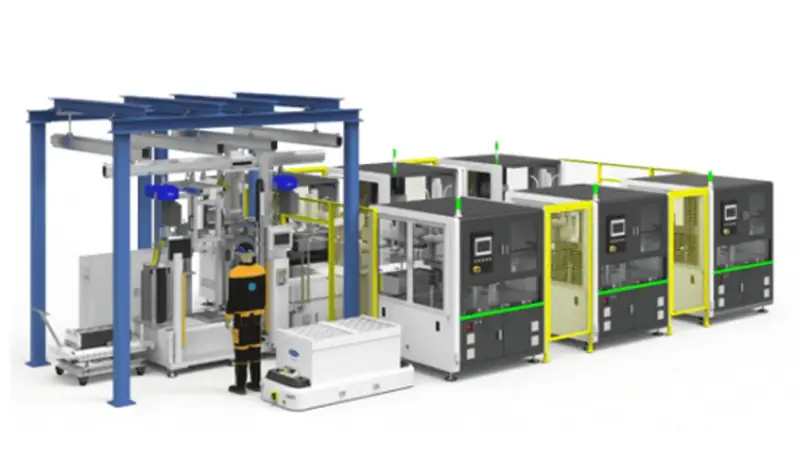
Analysis of the Dual-Valve Design in Second Intelligent’s Inline Precision Coating Solution
Background of the Solution
Based on Second Intelligent’s current inline precision coating solution and the customer’s process requirements (conformal coating machine+ localized precision dispensing), the core logic behind the design of the “Z-axis Dual Valve Assembly” is not simply to add another valve, but to solve the problem of “different process requirements existing on the same product” in electronic coating applications.
According to the solution proposal, the customer is currently using:
1.Conformal coating material
2.Viscosity: 15~20 cps (low viscosity)
3.Process requirements include
1.Large-area spray coating coverage
2.Localized precision dispensing / touch-up coating
3. Avoidance of complex PCB areas
4. Vision positioning and alignment correction
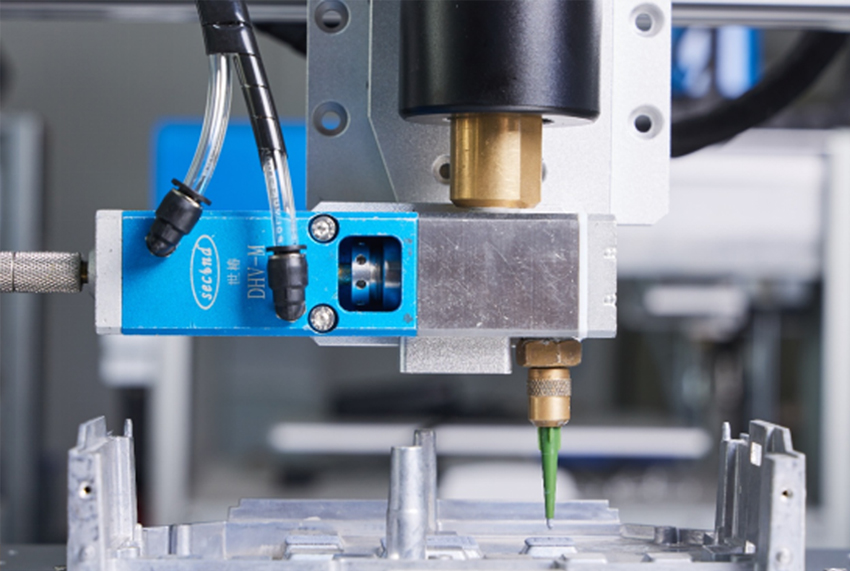
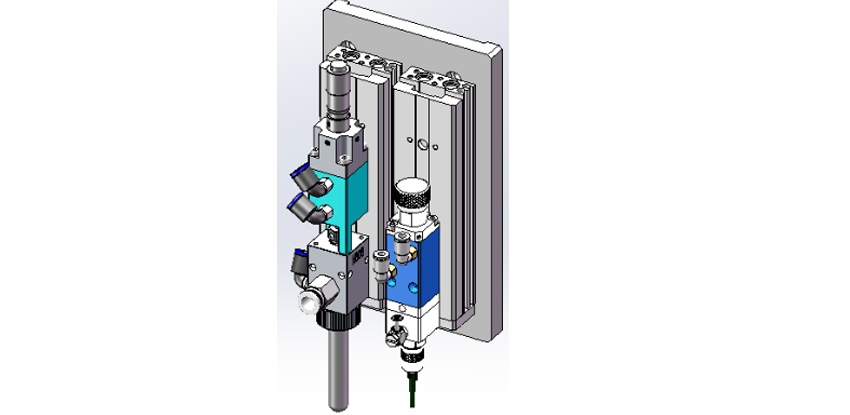
Therefore, Second Intelligent adopts, 1 set of Atomizing Spray Valve ,1 set of Needle Valve ,Z-axis Dual Valve Switching Assembly.
The essence of this design is to solve the following problems:
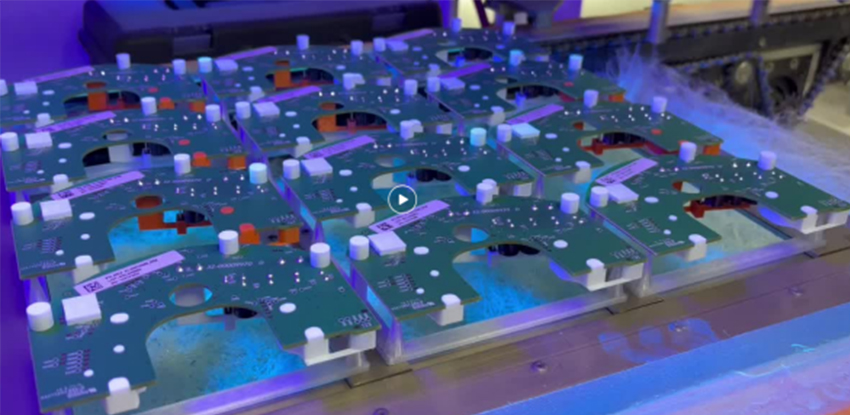
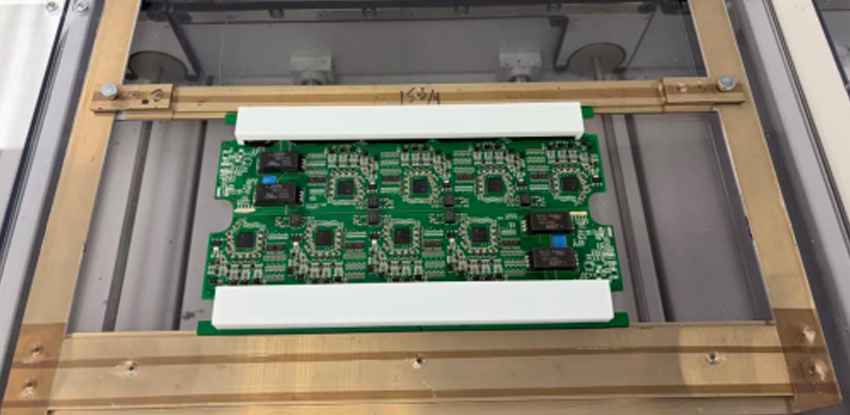
I. Why is a Dual Valve Assembly Necessary?
1. A Single Valve Cannot Balance “Large-area Efficiency” and “Local Precision”
The atomizing spray valve and the needle valve are fundamentally two completely different process technologies.
Advantages of Atomizing Spray Valve
Suitable for:Large-area conformal coating,Uniform thin-layer spraying,High-efficiency coverage,Smooth edge transition.
However, its limitations include,Not suitable for narrow areas
Not suitable for high-precision touch-up dispensing
Easy to generate overspray
Insufficient protection for connectors, PINs, and slots
Advantages of Needle Valve
Suitable for,
Precision dispensing,Small-area touch-up coating,Corner repair,High-accuracy glue volume control
However, its limitations include:Low coverage efficiency
Slow speed for large-area coating
Not suitable for continuous surface spraying
Therefore:If the customer only uses a spray valve:
Local protection may be insufficient
Overspray may occur at edges
Dead corners may remain uncoated
If the customer only uses a needle valve:
The overall cycle time becomes too slow
Inline production capacity cannot be achieved
For this reason, Second Intelligent adopts a “Dual-Valve Process Integration” solution.
II. What Problems Does the Dual Valve Assembly Solve?
1. Solving Different Process Requirements Across PCB Areas
In electronic products, a single PCB often contains different coating requirements simultaneously:
Area | Process Requirement |
Large component areas | Spray coating |
IC edges | Precision touch-up dispensing |
Connector interfaces | Coating avoidance |
PIN areas | Micro dispensing |
High-frequency components | Reinforced protection |
Sensitive local areas | Precise coating control |
With the dual-valve structure
The spray valve handles “surface coating”
The needle valve handles “point dispensing”
This enables a combined “Surface + Point” coating process.
2. Solving the Shadow Effect in Conformal Coating
Due to varying component heights on electronic assemblies, spray coating can easily be blocked by taller components.
This may lead to:
Uncoated component sidewalls
Insufficient lead protection
Dead zones underneath components
In such cases, the needle valve can perform:
Secondary touch-up dispensing
Edge repair
Deep-slot precision coating
Thus significantly improving overall coating coverage.
3. Solving Frequent Product Changeover Requirements
In the future, customers may need to:
Change PCB models
Change coating materials
Adjust process requirements
The dual-valve system provides higher flexibility:
One platform compatible with multiple processes
No need for frequent equipment modification
Reduced future CAPEX investmen
This is a critical capability for inline production equipment.
4. Improving Overall Production Yield
In conformal coating applications, the real challenge is not simply “applying coating,” but achieving:
No missing coating
No overspray
No stringing
No contamination on connectors
No contamination on test points
No impact on downstream assembly
The dual-valve structure essentially improves final yield by assigning different coating tasks to different valve technologies.
III. Core Advantages of Second Intelligent’s Dual Valve Design
Second Intelligent’s dual-valve assembly adopts:
Slide-cylinder lifting structure
Independent dual-valve operation
CCD vision integration
Compatibility with multiple valve types
This provides several core advantages:
1. One Platform for Two Processes
Customers do not need:
Two separate machines
Two production processes
Two material handling steps
The system can complete:
Spray coating
Precision dispensing
On a single platform.
This reduces:
Labor cost
Floor space
Logistics time
Online switching cost
2. Improved CT (Cycle Time)
In traditional solutions:
Manual touch-up is often required after spraying
With Second Intelligent’s dual-valve system:
Automatic spraying
Automatic touch-up dispensing
Automatic valve switching
This significantly reduces:
Manual rework
Secondary repair
Offline repair processes
Which is highly valuable for inline production lines.
3. Improved Process Stability
The needle valve handles:
Starting points
End points
Corners
Narrow areas
The spray valve handles:
Large-area continuous coating
Compared with a single-valve solution, this provides:
More uniform coating thickness
More stable edge quality
Higher process consistency
4. More Suitable for High-end Electronics Manufacturing
Especially suitable for:
Automotive electronics
New energy control boards
Industrial control PCBs
Communication boards
Medical electronics
Because these industries require extremely high coating consistency and reliability.
IV. Core Advantages of Second Intelligent’s Inline Precision Dispensing & Coating Platform
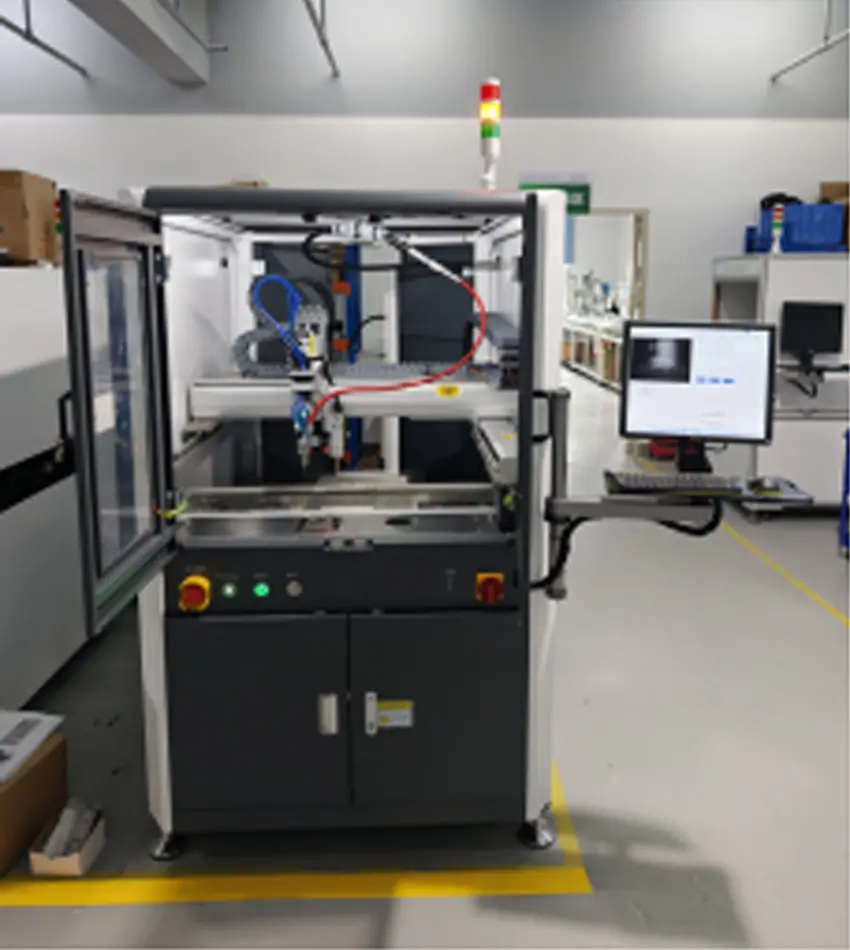
The core competitiveness of Second Intelligent’s inline platform can be summarized as follows:
1. Integrated “Dispensing + Spraying + Vision” Capability
Second Intelligent is not simply a machinery supplier.
It provides a complete fluid application process solution.
The platform integrates
Atomizing spray valve
Needle valve
CCD vision system
Glue supply system
Motion control
MES interface
This is a capability many single-function equipment suppliers do not possess.
2. High-Precision Motion Platform
System specifications include:
Repeatability: ±0.015mm
XY speed: 800mm/s
Panasonic servo motors
TBI ball screws
HIWIN linear guides
This demonstrates that Second Intelligent not only “does dispensing,” but also possesses true precision motion control capability.
3. Strong Vision Alignment & Correction Capability
The system is equipped with:
Mark point positionin
Automatic alignment correction
Path compensation
Barcode recognition
MES data upload
This means that even if the PCB has:
Incoming material deviation
Fixture tolerance
Thermal deformation
The system can automatically compensate for these deviations.
This is a key requirement for inline automation.
4. High Compatibility & Expandability
Second Intelligent’s solution is compatible with:
Atomizing valves
Needle valves
Different lighting systems
Various coating materials
Multiple product sizes
Customers can upgrade future processes without replacing the entire platform.
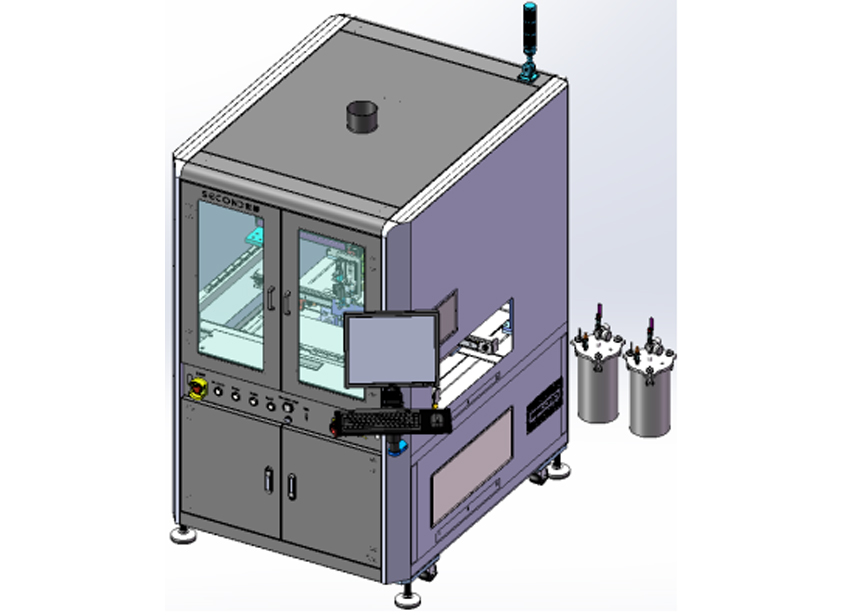
Second Intelligent’s dual-valve inline precision coating solution is not simply about adding another dispensing valve. Instead, it adopts a combined “spraying + precision touch-up dispensing” process design to solve the challenge of balancing large-area coating efficiency and localized high-precision coating in electronic conformal coating applications.
The atomizing valve achieves high-speed and uniform coating coverage, while the needle valve enables precision touch-up coating in complex areas. Combined with the CCD vision auto-correction system, the solution effectively reduces missing coating, overspray, shadow effects, and manual rework risks, significantly improving product yield, process stability, and production automation efficiency.
Second Intelligent’s inline platform features high-precision motion control, vision positioning, fluid management, and MES compatibility, making it highly suitable for automotive electronics, new energy, industrial control, communication, and other high-end electronics manufacturing industries requiring high consistency and high reliability conformal coating processes.