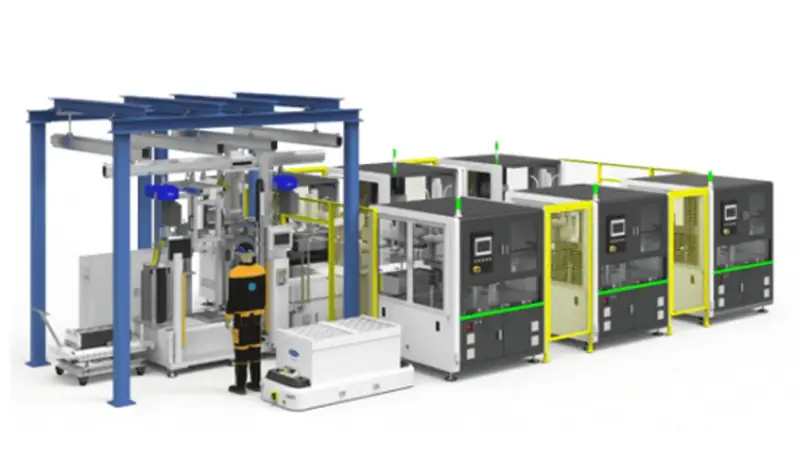
Using a desktop dispensing machine with two-component servo adhesive dispensing technology for heat sinks in electrical appliances is an advanced process solution that significantly improves dispensing accuracy, production consistency, and adhesive utilization.
I. Core Process Flow
The core of this solution is the use of a servo motor-driven dispensing mechanism to replace the traditional pneumatic method, independently and precisely extruding and pushing the two components of adhesive, A and B. Subsequently, the adhesive is thoroughly mixed in a static mixing tube and finally precisely coated onto the heat sink.
Typical Process Flow (Heat Sink Dispensing)
1. Equipment Configuration
General desktop dispensing platform configuration:
● XYZ three-axis desktop dispensing machine
● Dual servo pressure dispensing system (one line each for adhesive A and adhesive B)
● Static mixing tube
● Dispensing valve (anti-drip valve recommended)
● Vacuum degassing dispensing tank (optional)
● Heating platform (optional)
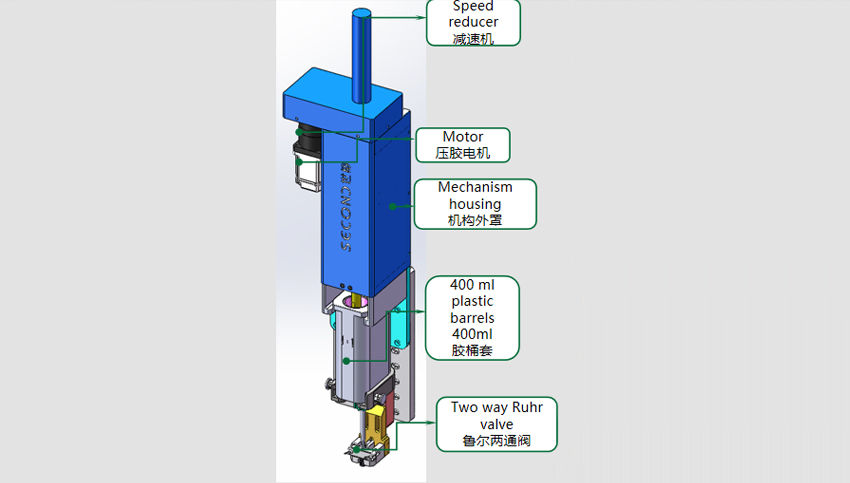
Two-component servo adhesive dispensing
What you call “Two-component servo adhesive dispensing ” essentially means: two independent servo motors push the two adhesive cylinders, A and B, synchronously according to a set ratio.
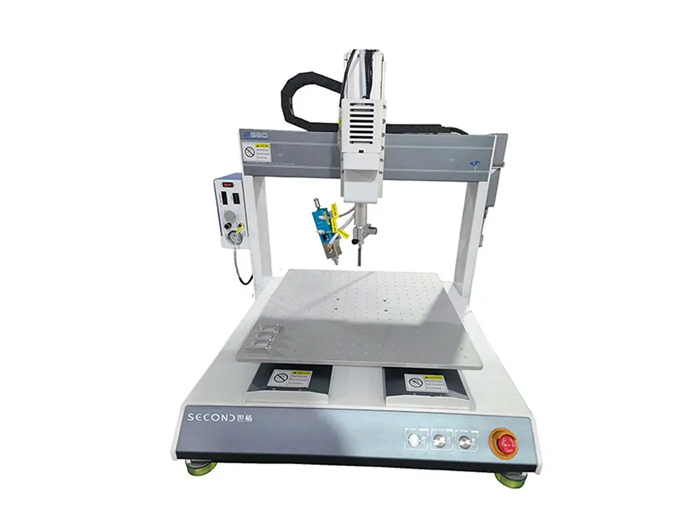
Glue Dispensing Machine SEC-E580
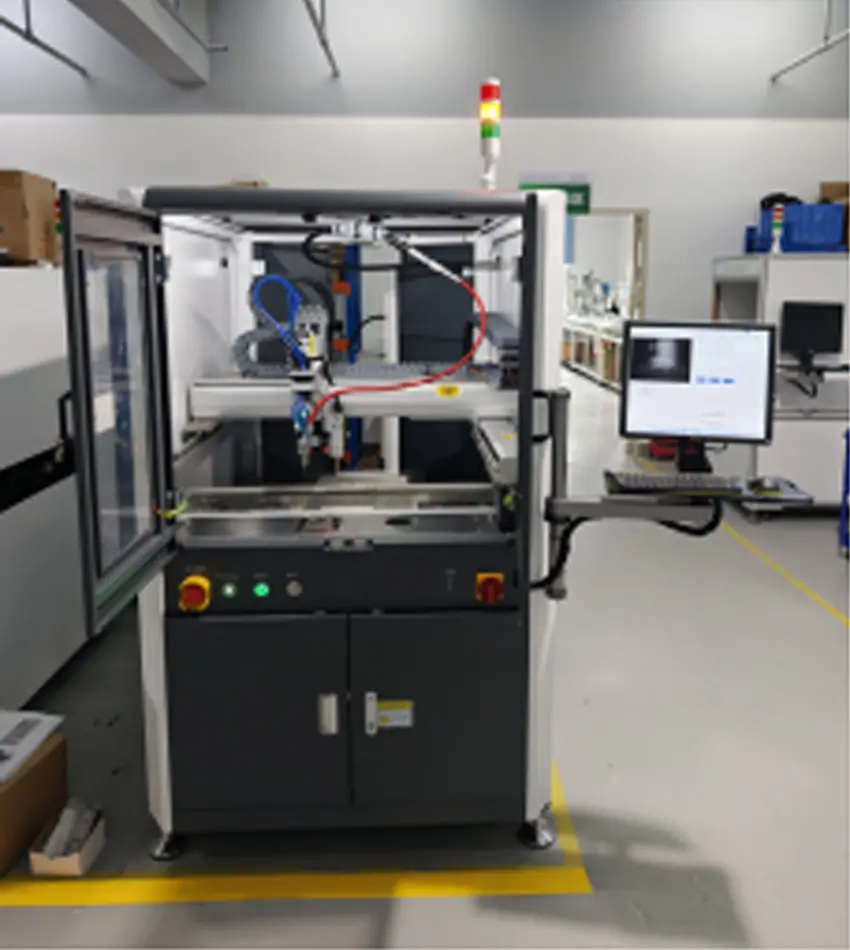
Second Intelligent Desktop Glue dispensing Machine SEC-E580 has achieved the transition from manual gluing to semi-automation. It is the largest desktop dispensing machine. It adopts aviation aluminum alloy casting design and one-piece molding processing, with high strength and stable operation. The X/Y axis transmission assembly is directly installed on the casting. It can reduce the number of parts and improve assembly efficiency. efficiency. It is equipped with CCD visual height measurement, which makes programming more efficient and more accurate.
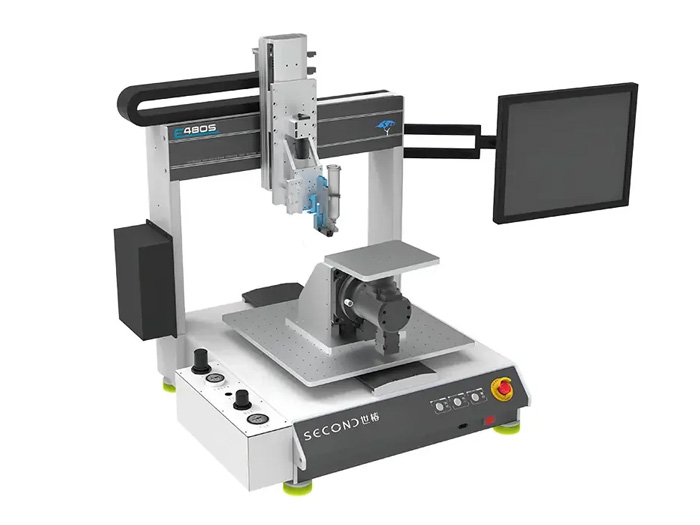
Desktop glue dispensing machine robot SEC-E480SV with CCD visual
Second Intelligent Desktop Glue Dispensing Machine SEC-E480SV adopts high-precision servo motor + grinding ball screw, which can ensure accuracy while having higher cost performance. It is also equipped with CCD visual height measurement, which makes programming more efficient and more accurate. It is an aviation aluminum alloy die-casting one-piece design desktop glue dispensing machine, which is more solid, more stable, with double rotating stations, small and flexible.
Ⅱ.Implementation Steps and Key Technologies
1.Equipment and Adhesive Preparation
●Equipment Selection: Ensure your desktop dispensing machine has XYZ three-axis linkage and is equipped with a two-component servo pressure dispensing system. Simultaneously, select a suitable dispensing device based on the adhesive ratio (e.g., 1:1, 2:1, etc.) and packaging specifications (e.g., 50ml, 400ml).
●Adhesive Confirmation: This is a crucial step. Confirm the mixing ratio, viscosity, working time, and curing conditions of the two-component thermally conductive adhesive used. These parameters directly determine the subsequent process parameter settings.
2.Precise Control and Adhesive Dispensing
●Advantages of Servo-driven adhesive dispensing : Compared to traditional pneumatic methods, the servo motor + ball screw transmission scheme provides stable and linear thrust, unaffected by changes in the remaining adhesive in the glue tank, fundamentally ensuring consistent dispensing volume throughout the process. Some advanced systems also integrate pressure sensors for real-time monitoring of pressure force, achieving closed-loop control.
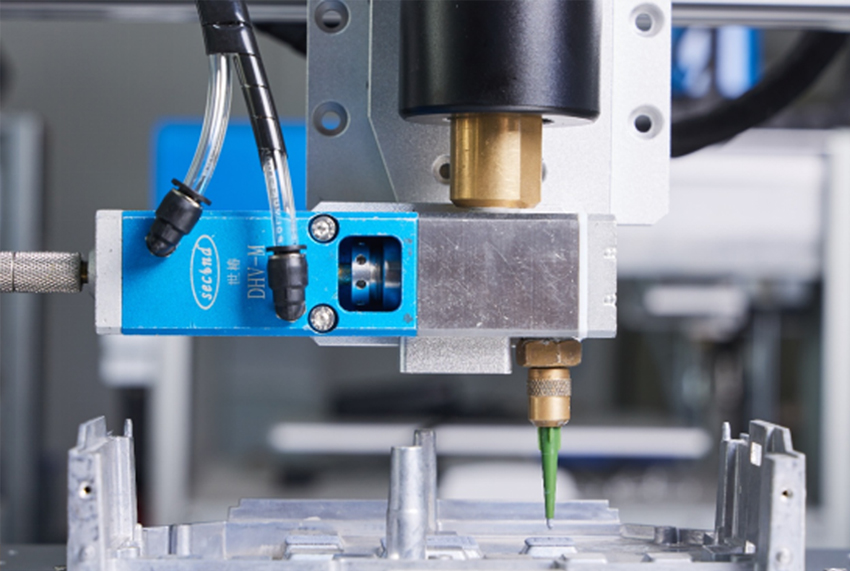
●Precision Dispensing Valve: To achieve high-precision coating, the dispensing head often uses a screw valve. It is driven by a servo motor and precisely measures the amount of adhesive dispensed by rotating the screw, with a control accuracy of within ±2%, making it especially suitable for high-viscosity thermally conductive adhesives.
3.Adhesive Circuit Design and Mixing
●Static Mixing: Components A and B enter the static mixing tube under pressure. The spiral structure within the tube continuously divides and reassembles the adhesive, achieving uniform mixing.
●Cooling to Delay Curing:If the two-component adhesive dispensing has a very short working time (within minutes), consider equipping the mixing tube with a cooling mechanism. Lowering the temperature of the mixed adhesive effectively slows down the chemical reaction, increasing the valuable working time window.
4.Automated Dispensing Operation
●Programming and Positioning: Dispensing paths (dots, lines, circles, or complex curves) are set via a handheld programmer or by importing CAD files. Desktop dispensing machines equipped with a CCD vision system automatically identify the heat sink outline and perform position correction, ensuring accurate adhesive application.
●Height Compensation: Minor unevenness may exist on the heat sink surface. By adding an infrared or laser height sensor, the system can detect and compensate for Z-axis height changes in real time, ensuring consistent dispensing height and uniform adhesive layer thickness across different planes.
●Intelligent Back-Suction: At the end of dispensing, the servo system can perform a momentary “back-suction” action, effectively preventing glue stringing or dripping and keeping the product clean.
5.Curing and Quality Verification
●Curing Process: Select room temperature or heated curing based on the characteristics of the thermally conductive adhesive. For PCBAs containing heat-sensitive components, a stepped heating scheme is recommended to avoid thermal shock damage to the devices.
●Quality Inspection: Process verification is essential before mass production. Common inspection methods include:
a.Visual Inspection: Confirm that the coating path and width meet requirements.
b.Thickness Measurement: Use a thickness gauge to ensure the adhesive layer thickness meets the design value (eg, some cases require a thermally conductive gel thickness greater than 0.8mm).
cX-Ray Inspection: Non-destructive testing to detect the void ratio inside the adhesive layer. Generally, a void ratio of less than 5% is required to ensure optimal thermal conductivity.
III. Application Advantages at a Glance
Compared to traditional manual or semi-automatic methods, this solution offers significant advantages:
●High Precision and Consistency: Servo-controlled dispensing accuracy far surpasses that of traditional pneumatic methods, ensuring consistent product quality.
●High Efficiency: Automated operation can run continuously for 24 hours, and combined with high-speed motion control, it significantly increases output per unit time.
●Adhesive Savings: Precise dispensing control avoids over-coating and waste, reducing material costs.
●Easy Operation: The desktop dispensing machine features intuitive programming, quick line changes, and flexible adaptation to multi-variety production.
Second Intelligent has played an important role in theresearch, development, manufacturing, pre-sales and after-sales services of fluid dispensing robot , potting and coating solutions which range from various types of automatic fluid dispensing, potting, two-component potting machines and coating machines with desktop, free-standing, inline or cobot combined systems, and widely used in global electrical, electronics, home appliances, automobile, telecom, pharmaceutical, automotive electronics, semiconductor, aerospace, LED and more.