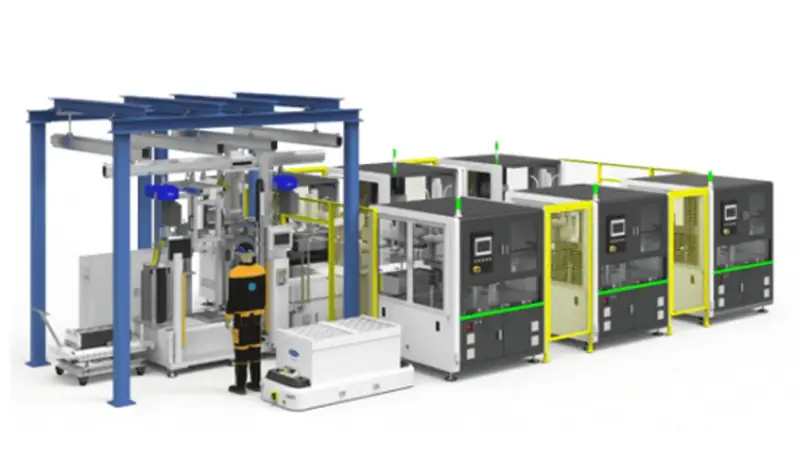
In automated dispensing production, manufacturers commonly encounter issues such as inconsistent dispensing, stringing, valve clogging, adhesive corrosion, and insufficient dispensing accuracy. In most cases, these problems are not caused by equipment failure or improper operation, but by a mismatch between the dispensing valve and the adhesive properties.
The dispensing valve is the core dispensing component of an automated dispensing system, directly determining dispensing accuracy, stability, and production yield. Since different adhesives vary significantly in viscosity, stringing behavior, corrosiveness, filler content, and curing characteristics, they require completely different valve structures, wetted materials, and dispensing methods.
All dispensing valves from Second Intelligent are independently designed and developed in-house. Leveraging years of expertise in precision fluid control technology, each valve is optimized for specific adhesive characteristics, helping eliminate common dispensing issues caused by improper valve selection and ensuring stable, high-volume production across a wide range of industries.
This guide focuses on the key properties of adhesives and introduces the application scenarios, advantages, and selection considerations of Second Intelligent’s six major dispensing valve series, providing a practical and standardized valve selection reference.
I. Core Selection Principle: Choose the Valve Based on Adhesive Properties
Many users prioritize dispensing accuracy, price, or brand when selecting a dispensing valve. However, the first and most important criterion is compatibility between the valve and the adhesive. Dispensing accuracy, efficiency, operating cost, and service life all depend on selecting the right valve for the adhesive and production process.
The following five adhesive characteristics are the primary factors that determine valve selection.
1. Adhesive Viscosity: Determines Dispensing Force and Valve Structure
Viscosity is the most fundamental physical property of an adhesive and directly determines the dispensing mechanism and flow channel design.
● Low-viscosity adhesives flow easily and tend to drip or penetrate, requiring valves with excellent sealing performance, precise micro-dispensing capability, and leak prevention.
● High-viscosity adhesives are thick and difficult to flow, requiring reinforced valves with high dispensing force, large flow passages, and excellent anti-clogging performance.
2. Stringing and Flow Characteristics: The Key to Preventing Tailing and Overflow
Silicone, epoxy, and hot melt adhesives naturally exhibit stringing characteristics. Conventional valves may leave adhesive strings after closing, resulting in tailing, uneven bead width, adhesive overflow, and contamination of the workpiece.
In contrast, adhesives such as cyanoacrylate, alcohol, and conformal coating generally do not string. For these materials, the primary concerns are leakage prevention, corrosion resistance, and stable dispensing rather than string-cutting capability.
3. Chemical Activity and Curing Characteristics: Determine Valve Type, Materials, and Mixing System
The chemical activity, curing speed, and whether an adhesive is single-component or two-component are often overlooked during valve selection. These factors determine whether a dedicated mixing system or chemically resistant wetted materials are required, and play a critical role in preventing premature curing, valve clogging, adhesive degradation, and poor bonding performance.
(1) Selection Differences Between One-Component and Two-Component Adhesives
Single-component adhesives, including UV adhesives, one-part silicone, cyanoacrylate, and anaerobic adhesives, cure through external conditions such as UV light, temperature, or moisture. Standard dispensing valves are generally suitable, provided they offer corrosion resistance, leak prevention, and basic anti-stringing performance.
Two-component adhesives, such as AB adhesives, two-part epoxy, and two-part polyurethane, become highly reactive once Components A and B are mixed. Standard single-fluid dispensing valves must not be used for these materials.
Instead, two-component adhesives require a dedicated two-component dispensing system equipped with a specialized mixing valve. The length of the static mixer should be selected according to curing speed, mixing ratio, and dispensing volume.
● Faster curing adhesives and smaller dispensing volumes require shorter static mixers to prevent premature curing inside the mixer.
● Slower curing adhesives and high-volume potting applications can use standard-length static mixers to ensure complete mixing and accurate ratio control, preventing insufficient mixing, bond failure, and valve damage.
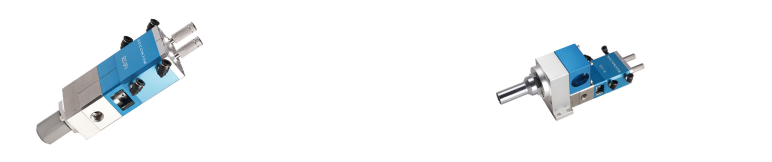
Dual-Component Static Mixing Valve Dual-Component Dynamic Mixing Valve
(2) Material Compatibility Requirements for Highly Reactive Adhesives
Highly reactive adhesives such as anaerobic adhesives, UV adhesives, and cyanoacrylates are extremely sensitive to contact materials, light, and air. Contact with ordinary metal valve components may trigger premature curing, crystallization, or adhesive degradation.
For these materials, all wetted components should be manufactured from chemically inert materials such as PTFE (Teflon) or high-performance engineering plastics to completely isolate the adhesive from metal surfaces and eliminate valve clogging, adhesive deterioration, and dispensing defects.
4. Filler Content: Preventing Valve Wear and Clogging
Silver conductive adhesives, thermally conductive potting compounds, ceramic-filled adhesives, polishing compounds, and metal-filled adhesives contain hard solid particles that are highly abrasive.
Conventional precision valves with narrow flow passages and delicate valve cores are prone to wear, clogging, sticking, and leakage under these conditions.
Such applications require dispensing valves with wear-resistant materials, large flow channels, and anti-clogging designs.
5. Environmental Resistance: Supporting Valve Selection for Different Operating Conditions
Some adhesives must operate under high temperatures, low temperatures, high humidity, or oxidation-sensitive environments.
Combined with challenging production environments such as temperature fluctuations, humidity, and dust, valves should be selected with suitable temperature resistance, sealing performance, and protection levels to prevent seal aging, material deformation, adhesive degradation, leakage, and unstable dispensing.
II. Selecting the Right Dispensing Valve for Different Adhesive Types
Based on the characteristics of commonly used industrial adhesives, the following sections summarize the recommended applications, advantages, and typical use cases for six major dispensing valve types.
1. Low-Viscosity, Corrosive, Non-Stringing Fluids | Recommended: Diaphragm Valve
Suitable Adhesives
● Cyanoacrylate (CA)
● Anaerobic adhesive
● Flux
● Anhydrous alcohol
● Solvents
● Low-viscosity UV adhesive
● Solvent-based fluids
Adhesive Characteristics
These materials exhibit extremely low viscosity, excellent flowability and penetration, fast curing, and in some cases corrosive properties. Conventional metal valves are susceptible to leakage, adhesive buildup, and corrosion.
Valve Advantages
The diaphragm valve is the preferred solution for these applications. Featuring a seal-less wetted chamber and corrosion-resistant sealing materials such as UHMW polyethylene and PTFE, it completely isolates the adhesive from metal components, eliminating corrosion and leakage.
Its superior sealing performance effectively prevents dripping and adhesive accumulation while offering a simple structure, high reliability, and easy maintenance.
Selection Tips
Avoid using conventional needle valves or screw valves with corrosive low-viscosity fluids, as metal flow paths may corrode rapidly, resulting in valve failure, adhesive contamination, and product defects.
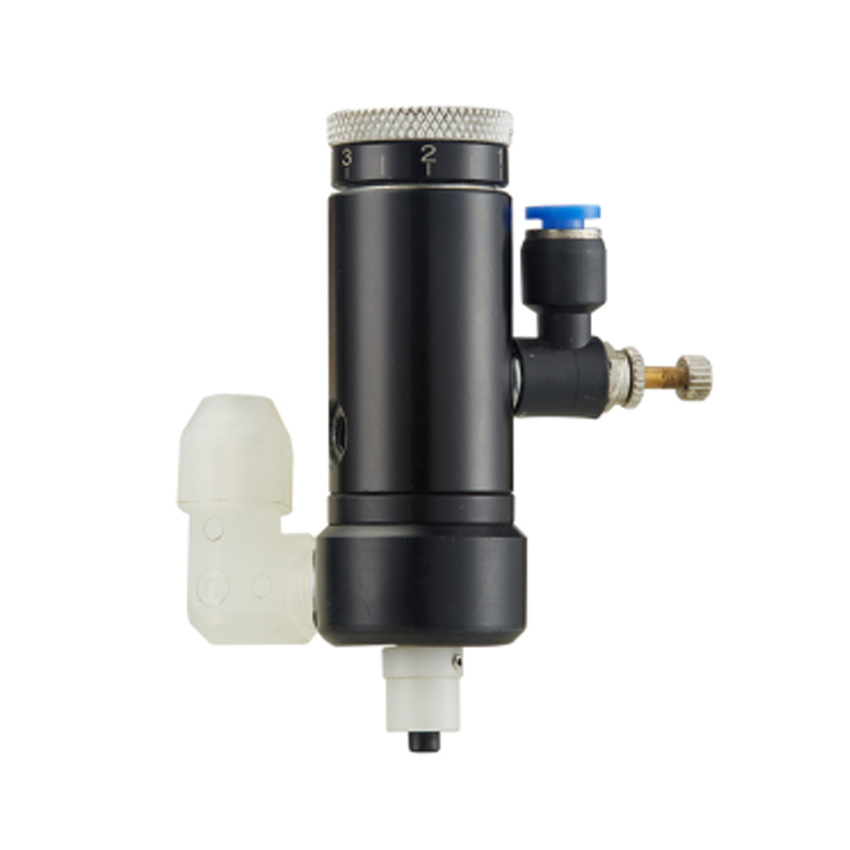
Diaphragm Valve
2. Medium-Viscosity, High-Stringing Adhesives | Recommended: Suck-Back Dispensing Valve
Suitable Adhesives
● RTV silicone
● Glass adhesive
● General epoxy
● Standard AB adhesive
● Damping adhesive
● Medium-viscosity UV adhesive
Adhesive Characteristics
These adhesives have moderate viscosity and excellent flow characteristics but exhibit significant stringing, often causing tailing, overflow, inconsistent bead size, and contamination.
Valve Advantages
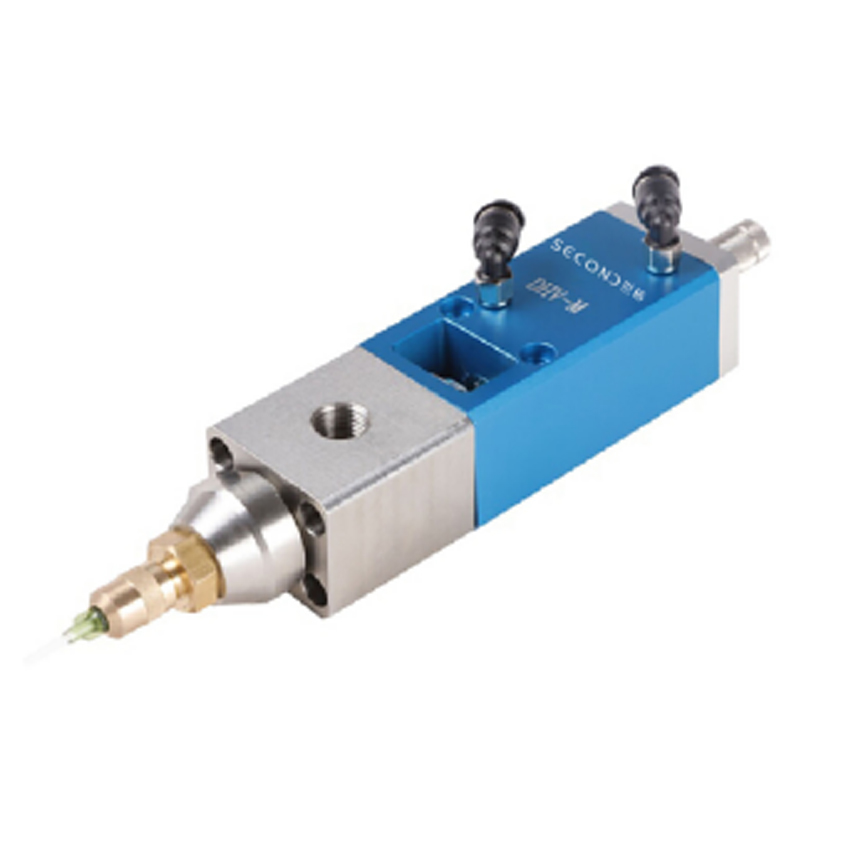
The suck-back valve retracts a small amount of adhesive immediately after valve closure, effectively cutting off adhesive strings and eliminating tailing. It provides highly consistent dispensing and is ideal for continuous bead dispensing, circular sealing, and gasket applications.
Its versatility and cost-effectiveness make it a preferred solution for electronics encapsulation, waterproof sealing, and general bonding processes.
Selection Tips
Avoid conventional needle valves when dispensing highly stringing adhesives. For two-component stringing adhesives, always use a dedicated two-component dispensing system together with an appropriately sized static mixer to prevent poor mixing and premature curing.
3. High-Viscosity Adhesives with Light Fillers | Recommended: Needle Valve or Screw Valve
Suitable Adhesives
● High-viscosity epoxy
● Sealants
● Thermally conductive silicone
● SMT red glue
● Solder paste
● Thick adhesives with fine fillers
Adhesive Characteristics
These materials exhibit high viscosity, low flowability, and significant dispensing resistance. Some also contain fine fillers that increase dispensing difficulty.
Valve Advantages
For high-volume dispensing applications, the needle valve offers high dispensing force, a robust structure, and a large flow channel that minimizes clogging while remaining durable and easy to maintain.
For precision dispensing of small adhesive volumes, the screw valve provides superior performance. By continuously rotating the screw, it delivers highly stable volumetric dispensing that is minimally affected by viscosity variations, making it ideal for precision encapsulation and micro-dispensing applications.
For precision dispensing of small adhesive volumes, the screw valve provides superior performance. By continuously rotating the screw, it delivers highly stable volumetric dispensing that is minimally affected by viscosity variations, making it ideal for precision encapsulation and micro-dispensing applications.
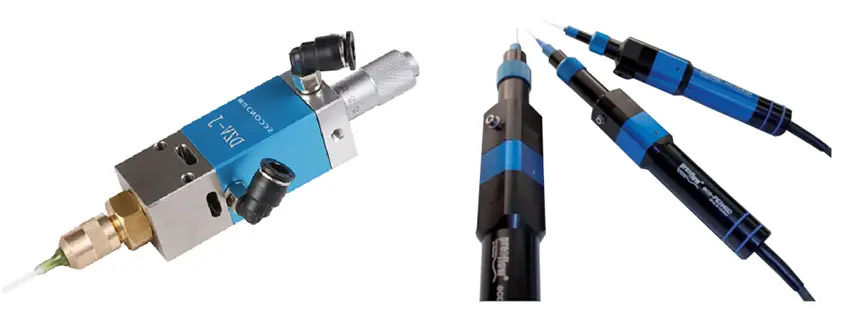
4. Highly Abrasive Filled Adhesives | Recommended: Wear-Resistant Screw Valve or Reinforced Large-Orifice Needle Valve
Suitable Adhesives
● Silver conductive adhesive
● Highly filled thermal potting compound
● Ceramic-filled coating
● Polishing compound
● Heavy solder paste
● Wear-resistant protective coating
Adhesive Characteristics
These adhesives contain hard ceramic or metallic particles that rapidly wear conventional precision valves, causing clogging, leakage, and premature valve failure.
Valve Advantages
Wear-resistant dispensing valves use hardened alloy or ceramic valve cores and flow passages to withstand abrasion and impact.
Combined with enlarged flow channels, these designs minimize particle accumulation, reduce maintenance frequency, and significantly extend valve service life during continuous production.
Selection Tips
Do not use piezo jet valves or miniature diaphragm valves with particle-filled adhesives, as their precision flow channels can be permanently damaged by abrasive fillers.
5. High-Speed, Ultra-Precision Micro Dispensing | Recommended: Piezo Jet Valve
Suitable Adhesives
● Micro-dispensing UV adhesive
● SMT red glue
● Insulating adhesive
● Nano coating materials
● Medium- and low-viscosity precision fluids
Process Characteristics
These applications require nanoliter-level dispensing accuracy, extremely high speed, and non-contact dispensing while preventing stringing, substrate damage, and positioning errors.
Valve Advantages
The piezo jet valve uses high-frequency piezoelectric actuation to achieve non-contact jet dispensing with exceptional speed, repeatability, and dispensing consistency.
It is widely used in semiconductor packaging, sensors, miniature electronic components, and precision modules. Heated flow channels can also be incorporated for stable dispensing of specialized materials such as SMT red glue.
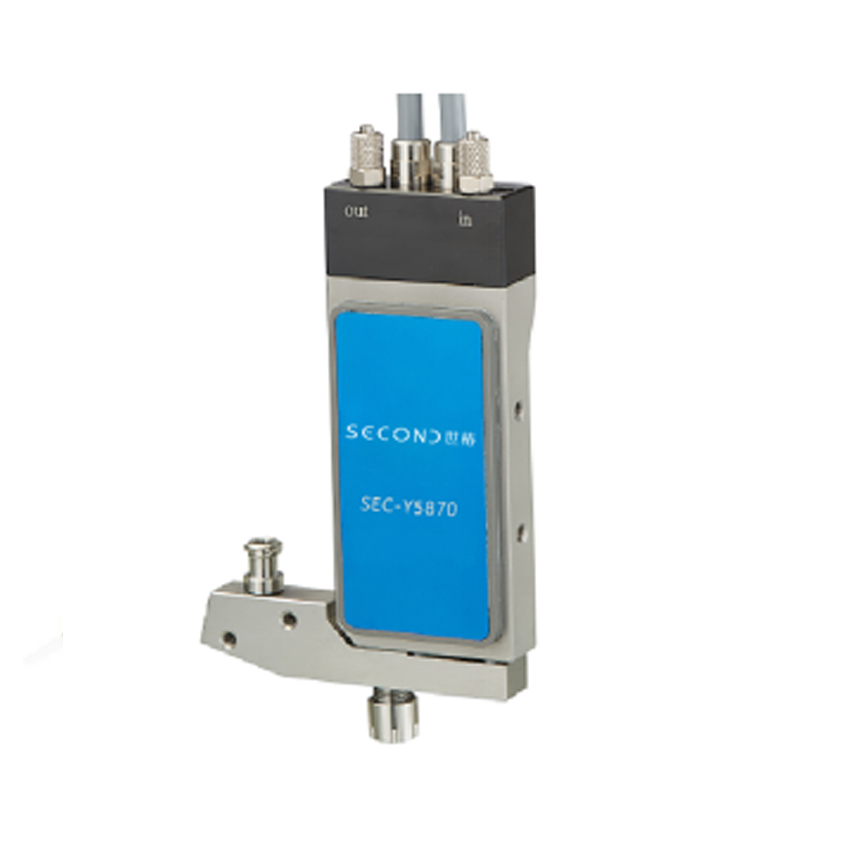
6. Large-Area Thin Coating Applications | Recommended: Spray Valve
Suitable Fluids
● PCB conformal coating
● Sprayable UV adhesive
● Release agents
● Rust inhibitors
● Protective coating fluids
Process Characteristics
These low-viscosity materials require uniform thin-film coverage over large areas rather than conventional dot or bead dispensing.
Valve Advantages
The spray valve atomizes the fluid into a fine, uniform coating with adjustable spray angles and consistent coverage, making it ideal for PCB conformal coating, surface protection, and large-area coating applications.
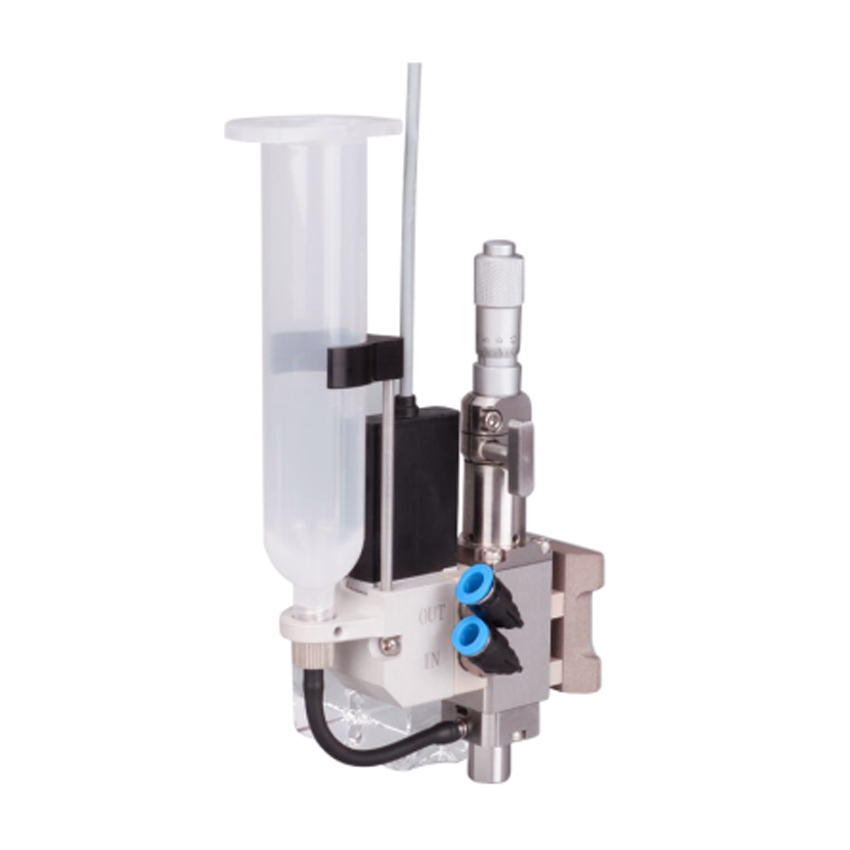
III. Common Dispensing Valve Selection Mistakes
Many dispensing defects result from incorrect valve selection rather than equipment failure.
The following mistakes should be avoided:
1. Choosing the highest-precision valve regardless of the application
Piezo jet valves and precision screw valves are designed for medium- and low-viscosity, particle-free, high-precision applications. Using them with high-viscosity or particle-filled adhesives increases clogging, wear, maintenance costs, and downtime.
2. Ignoring adhesive chemistry and valve material compatibility
Using standard metal valves for cyanoacrylate, anaerobic, or UV adhesives can cause premature curing, crystallization, and valve blockage. Likewise, using a standard single-fluid valve for two-component adhesives leads to poor mixing, abnormal curing, and bond failure.
3. Using standard valves for stringing adhesives
Without a suck-back mechanism, silicone and epoxy adhesives frequently produce stringing, overflow, and adhesive residue, negatively affecting appearance, sealing performance, and production efficiency.
4. Using precision small-orifice valves with particle-filled adhesives
Hard particles easily accumulate in narrow flow channels, causing blockage, excessive wear, dispensing inconsistency, production interruptions, and increased maintenance costs.
IV. Conclusion: Select the Right Dispensing Valve Based on Adhesive Characteristics
There is no universally “best” dispensing valve—only the most suitable valve for a specific adhesive and dispensing process.
The following selection guidelines are recommended:
● Low-viscosity fluids: Choose a diaphragm valve; for highly reactive fast-curing adhesives, select chemically inert wetted materials.
● Medium-viscosity, stringing adhesives: Choose a suck-back needle valve or piston valve.
● High-viscosity adhesives: Select a needle valve or screw valve according to dispensing accuracy requirements.
● Particle-filled adhesives: Use a wear-resistant screw valve or a large-orifice dispensing valve.
● Two-component adhesives: Employ a complete two-component meter mix dispensing machine, mixing, and dispensing system rather than a single dispensing valve.
● High-speed micro dispensing: Use a piezo jet valve.
● Large-area coating: Use a spray valve.
Successful dispensing valve selection is determined not by price or specifications, but by the precise match between adhesive properties, valve structure, wetted materials, and dispensing process.
With its complete portfolio of independently developed dispensing valves , Second Intelligent provides optimized solutions for a wide range of adhesives, production environments, and dispensing applications, effectively solving common manufacturing challenges such as inconsistent dispensing, stringing, valve clogging, corrosion, and dispensing inaccuracies while improving production yield and reducing maintenance and rework costs across diverse industries.