Ι.From the “Three-Axis Dilemma” to the “Four-Axis Breakthrough”
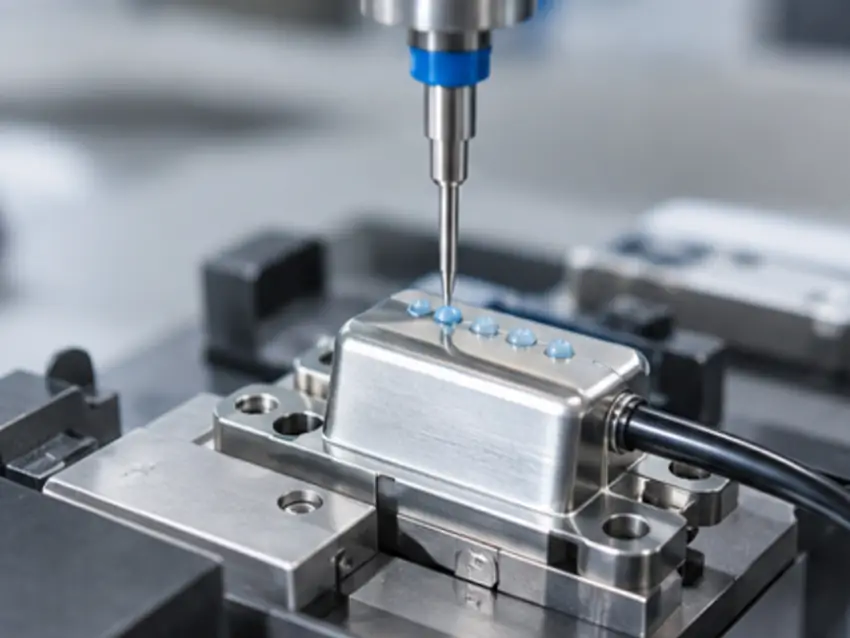
Traditional three-axis dispensing machines perform stably on planar straight lines, but they often fall short when faced with curved surfaces, vertical sidewalls, or product cavities. The glue gun can only move vertically downwards, and once it encounters a semi-circular surface, it either cannot reach it or produces uneven glue thickness—this “three-axis dilemma” has plagued the industry for many years.
The emergence of four-axis linkage technology has broken this bottleneck. Based on the linear motion of the X, Y, and Z axes, an additional R-axis rotation axis is added, achieving four-axis coordinated control and enabling the dispensing needle to move continuously along a three-dimensional curve in space. For a semi-circular surface, this means that the glue gun is no longer passively “dripping from top to bottom,” but actively “moving along the curved surface.”
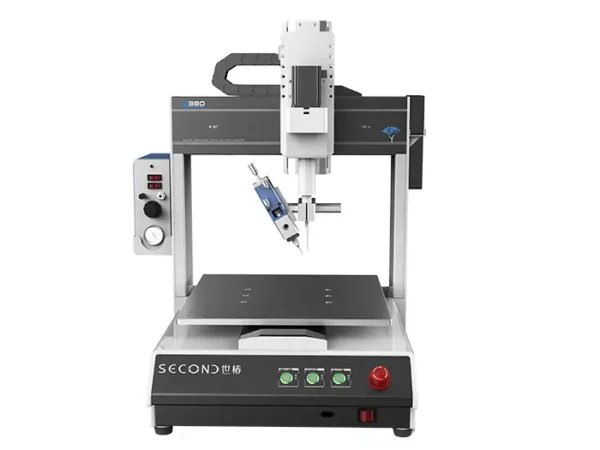
SEC-E380R 4 Axis Automatic Benchtop Glue Dispensing Machine
Second Intelligent SEC-E380R 4 Axis Automatic Benchtop Glue Dispensing Robot has the following advantages and features:
● One-piece casting, strong structure, stable operation; smaller size, larger stroke
● Adopting stepper motor + precision imported synchronous belt drive, it can ensure high accuracy and have higher cost performance.
● The size remains the same, but the travel is increased by 20-25%, making it more compatible
● A wide variety of products, single platform and dual platform options to meet the needs of different scenarios
● A variety of expansion modules to meet the needs of multiple industries and multiple process applications
Ⅱ.Core Technology: How the R-Axis Changes the Game
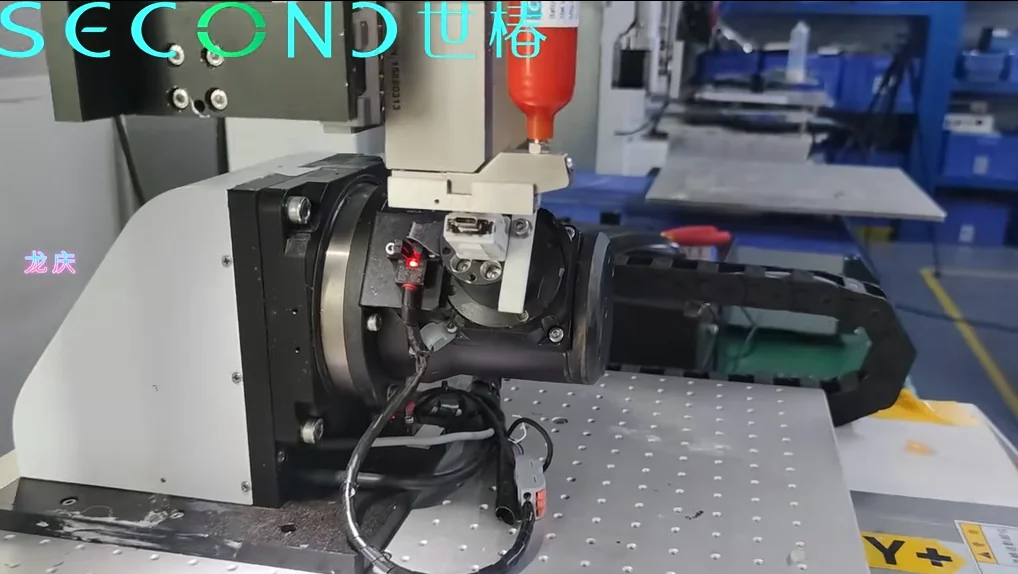
The core of a four-axis dispensing machine lies in the design of the fourth axis. Currently, there are two main solutions: one involves product-end rotation, adding a rotating shaft to the machine base plate and installing a positioning fixture to drive the product to rotate 360°, allowing the needle to maintain a fixed angle for dispensing onto the outer wall and inner cavity; the other involves needle-end rotation, adding a rotary motor at the end of the Z-axis, driving the dispensing syringe to rotate around its own axis via bevel gears or a splined shaft, achieving real-time adjustment of the needle angle.
For dispensing on semi-circular surfaces, the second solution is more advantageous. Because the needle dynamically deflects along the normal direction of the curved surface, it can always remain perpendicular to the curved surface or at the optimal angle, ensuring uniform glue adhesion without dripping. Patent CN216296934U discloses a structure using splined shaft transmission, where the rotary motor is supported by the frame slide rail, avoiding the problem of excessive load on the Z-axis module while ensuring that rotational movements do not affect the accuracy of vertical movement.
Semi-circular Surface Trajectory Planning: Algorithms are the Soul
Hardware alone is not enough; trajectory planning is the soul of four-axis linkage. The dispensing path for a semi-circular surface is not simply drawing an arc; it requires real-time coordination of four axes: the X-axis controls horizontal displacement, the Z-axis controls height changes, the R-axis synchronously adjusts the needle posture, and the Y-axis participates in the linkage according to the specific workstation requirements.
In actual programming, the arc command needs to be combined with preceding and following points to form a complete shape, and the set radius cannot be less than half the distance between the two points. This means that the points must be reasonably placed during teach programming to ensure a smooth transition of the arc.
An even greater challenge lies in speed consistency. The Benchtop Glue Dispensing robot process requires a uniform width of the entire glue line, meaning the trajectory speed must remain constant. If improper coordination of the four axes causes a sudden change in speed, resulting in glue piling up in slow areas and stringing in fast areas, the product will be scrapped. The industry solution is to introduce a speed look-ahead algorithm into the controller to perform interpolation calculations on the arc fitting points, allowing each axis to smoothly accelerate and decelerate at the junctions, avoiding jitter and loss of synchronization. The R-axis angular velocity is automatically adjusted according to the arc radius; the angular velocity is lower when the radius is large and higher when the radius is small, ultimately ensuring a constant linear velocity.
III. Key Details in Engineering Practice
In actual implementation, several details determine success or failure:
Needle Posture Compensation: The needle tip may not be on the R-axis rotation axis. If rotated directly, the needle tip position will shift. Tool center point compensation needs to be added to the control system to convert the rotation center to the needle tip position, ensuring that the rotational motion does not produce additional displacement.
Adhesive Quantity Synchronization Control: While the four-axis motion is in motion, the adhesive dispensing robot quantity needs to be linked to the speed—increase the dispensing pressure when the speed is high and decrease it when the speed is low to ensure a constant adhesive quantity per unit length. Some high-end controllers have integrated motion control and fluid control to achieve “speed-dependent quantity adjustment.”
Adhesive Cut-off and Reverse Suction: Adhesive dots are prone to accumulation or stringing at the start and end points of the arc. It is necessary to set early adhesive cut-off and delayed adhesive cut-off distances, and use a reverse suction function to cut off the adhesive tail.
Ⅳ.Application Prospects and Value
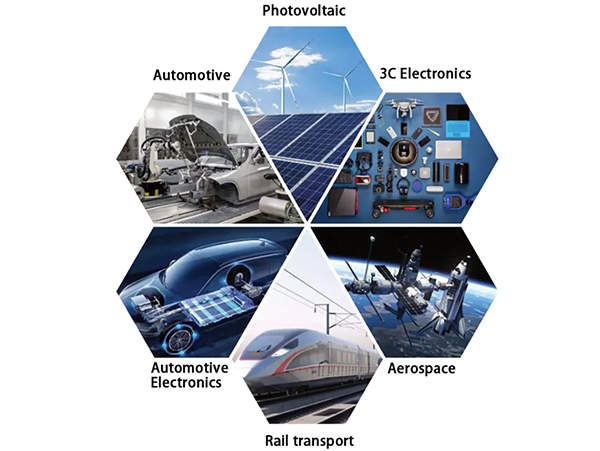
Four-axis linkage dispensing has been widely used in 3C electronics (mobile phone frame curved edges, battery bracket inner circular dispensing), packaging industry (wine box top and bottom curved edges, invisible adhesive processes), and new energy batteries (bracket inner wall coating), etc. Four-axis linkage dispensing technology is applied in industries such as new energy (battery module potting). This technology effectively solves the pain points of traditional equipment, such as “not being able to reach the target area” and “uneven coating,” and is a key process in precision manufacturing automation.
Compared to traditional three-axis solutions, the four-axis solution brings a qualitative leap in process feasibility—from “can it be done?” to “can it be done well?” For three-dimensional curved surfaces such as semi-circular arcs, it achieves optimal coating quality with the most streamlined mechanical structure, representing a crucial step towards three-dimensional precision manufacturing.
Second Intelligent has played an important role in theresearch, development, manufacturing, pre-sales and after-sales services of fluid dispensing robot, potting and coating solutions which range from various types of automatic fluid dispensing, potting, two-component potting machines and coating machines with desktop, free-standing, inline or cobot combined systems, and widely used in global electrical, electronics, home appliances, automobile, telecom, pharmaceutical, automotive electronics, semiconductor, aerospace, LED and more.