The application of five-axis tilting dispensing technology for fixing optical module PCBA boards primarily aims to overcome the bottlenecks of “physical space” and “positioning accuracy” that traditional three-axis solutions struggle to overcome when assembling dense, irregularly shaped, and highly precision-required optical modules. The core solution lies in a systematic approach integrating “hardware, software, fluid dynamics, and vision.”
Ⅰ.Core Challenge: Why is traditional dispensing “insufficient”?
In the assembly of 800G/1.6T optical modules, components such as lenses and chips on the PCBA board dispensing machine are extremely small and densely packed, presenting several typical challenges for fixing and dispensing:
● Poor physical interference and accessibility: Lens sizes can be as small as 1*0.8mm, with a spacing of only about 0.5mm. Conventional vertical dispensing needles simply cannot penetrate, and interference with surrounding tall components is likely.
● Loss of precision control in minute spaces:A deviation in glue dot position exceeding 0.05mm can affect optical path coupling efficiency. Traditional three-axis platforms struggle to achieve precise coating with equal height and width on three-dimensional curved surfaces.
● Severe visual positioning interference: The UV adhesive pre-filled at the bottom of the lens has a similar gray level to the edge of the lens itself, making it difficult for the vision system to accurately grasp the boundary and amplifying the positioning deviation.
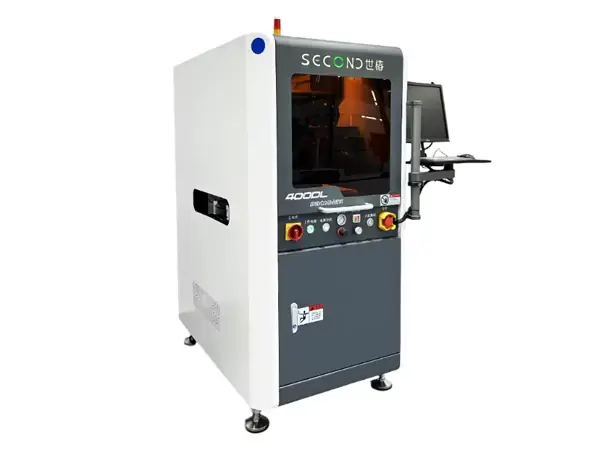
Automatic In-line PCB Glue Dispensing Machine SEC-DH400L
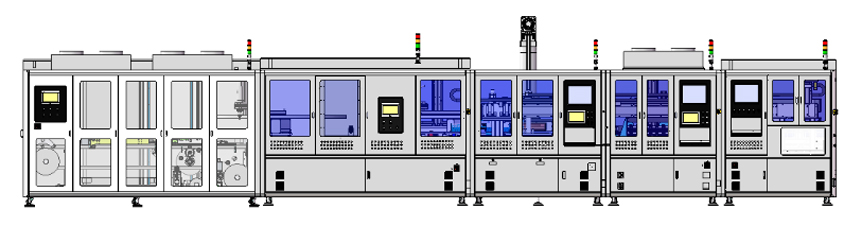
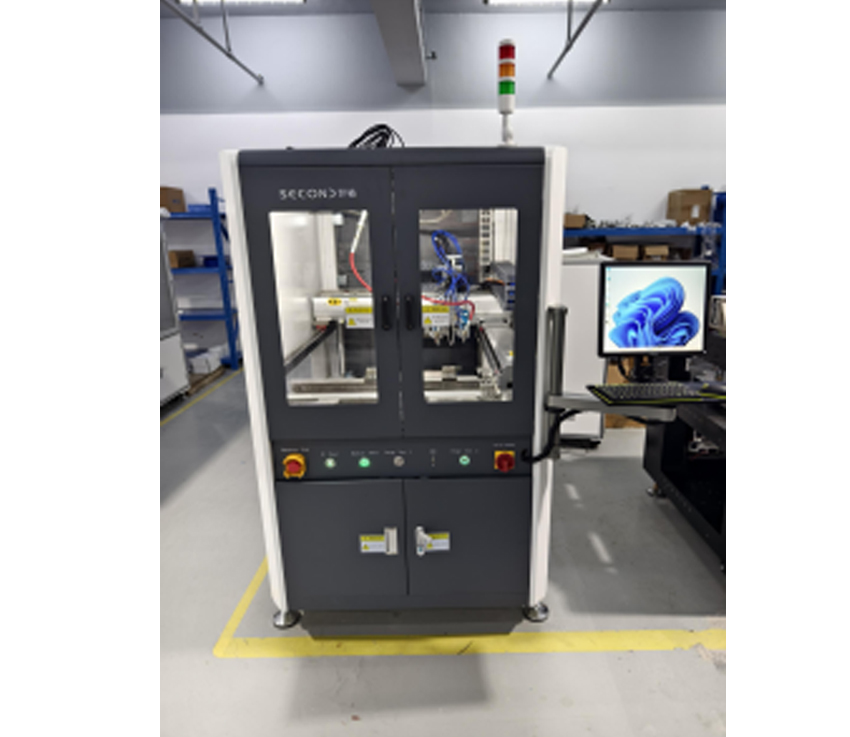
Second Intelligent In-line Automated Glue Dispensing Machine SEC-DH400L adopts an integrated mineral casting design, with ultra-high precision and super stability, powerful expansion capabilities, and can realize ion cleaning, dispensing, detection, UV exposure and other functions;
Adopting a gantry structure, it can bear large loads, stable structure, and a powerful CCD visual positioning system, which can meet the requirements of Mark point positioning, edge positioning, and 3D scanning positioning; strong scalability, and can expand AOI detection 3D detection, UV exposure curing and other functions;
Strong platform compatibility, contact and non-contact dispensing, single-head and multi-head synchronous dispensing, automatic compensation and adjustment of double-head spacing, five-axis dispensing function based on needle A/R displacement, etc.
Ⅱ.System Countermeasures: How to “break the deadlock” in five-axis dispensing solutions?
Five-axis dispensing, by adding a rotational axis (A/C axis), achieves real-time adjustment of the needle’s posture, thus “bypassing” obstacles and performing precise dispensing from the optimal angle.
1.Core Motion Control: Five-Axis Linkage and High-Precision Platform
● RTCP Tip Following Function: This is the core technology of five-axis dispensing machine. It ensures that the needle tip always aligns with the same point on the programmed path when moving around the rotational axis, achieving smooth, glue-free complex 3D trajectories, with glue layer thickness tolerance controllable within ±0.05mm.
● High-Rigidity Mechanical Platform: Utilizing a marble frame and linear motor drive, it ensures dynamic positioning accuracy within ±0.007mm, providing the foundation for micron-level dispensing.
2.Dispensing Execution: Customized Needles and Precision Glue Control
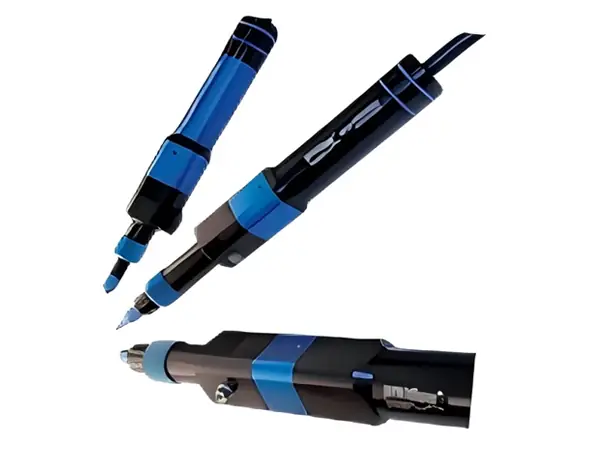
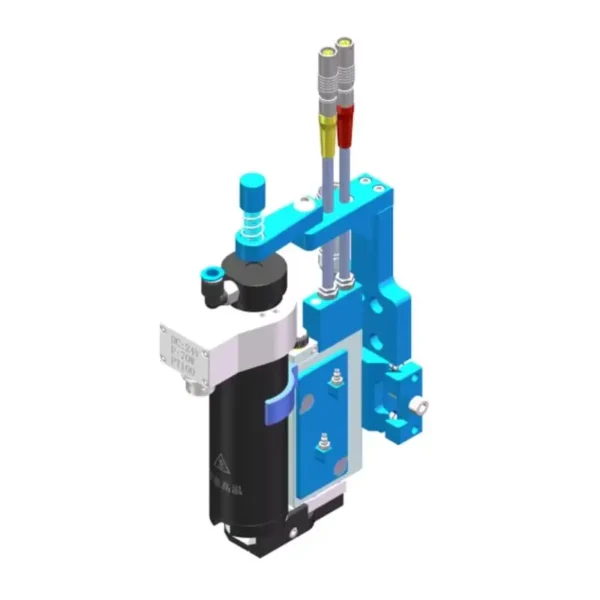
● Ultra-thin Wall Customized Needles: Customized needles with an inner diameter of 0.15mm and a wall thickness of only 0.04mm are used for extremely small gaps, easily inserting into narrow crevices and solving the physical problem of “not being able to insert the needle.”
● High Viscosity Glue Handling: Combined with a constant-temperature glue tank and a precision screw valve/piezoelectricjet valve, the problem of unstable dispensing of ultra-high viscosity glues (e.g., 800,000 cPs) due to temperature changes is solved, with glue volume fluctuations controlled within ±1%.
3.Perception and Decision-Making: Vision and Algorithm Collaboration
● Targeted Optical Solution:Through hundreds of lighting experiments, a high-precision telecentric lens combined with specific ring light is used to effectively eliminate bottom glue interference, making the lens boundary clearly visible and achieving precise positioning.
● AI Intelligent Path Planning:Combining 3D vision and AI algorithms, the system automatically identifies and compensates for workpiece position deviations, and can even dynamically adapt to changes in glue viscosity, ensuring batch consistency.
III. Typical Application Scenarios
The five-axis dispensing machine solution primarily addresses the following challenging fixing problems on optical module PCBA boards:
Application scenarios | Main difficulties | Five-axis countermeasures for high-strength component bottom reinforcement |
High-strength component bottom reinforcement | The pins of components on the PCB are prone to breakage due to vibration, and need to be reinforced by applying glue at an angle, but the vertical needle cannot reach the side. | With five-axis tilt and rotation, the needle precisely sprays at a certain angle onto the bottom or side of the component to achieve reinforcement. |
Side fixation of microlens | The lens size is small and the spacing is narrow, and the conventional needle cannot be inserted; the glue amount control is extremely demanding and cannot stick to each other. | Custom-designed ultra-thin-walled needles are inserted into the gaps, combined with five-axis attitude adjustment. Lines are drawn along the lens edge to ensure both fixation strength and non-adhesion. |
Annular/Irregular Cavity Seal | The optical module cavity has a ring structure, requiring continuous 360° adhesive application to the inner wall, R-corners, and other areas. Traditional triaxial methods are prone to adhesive leakage and buildup. | The hollow rotary table, combined with five-axis linkage, allows the needle to follow the surface normal in real time while the workpiece rotates, achieving 360° uniform coating without dead angles. |
In summary:
the key to overcoming the challenge of adhesive application for fixing optical module PCBA boards lies not in having five-axis technology, but in the ability to deeply couple four technologies: precision mechanics, motion algorithms, visual optics, and fluid control. A successful solution requires the precise planning and execution of each step, akin to “micron-level surgery.”
Second Intelligent has played an important role in theresearch, development, manufacturing, pre-sales and after-sales services of fluid dispensing robot, potting and coating solutions which range from various types of automatic fluid dispensing, potting, two-component potting machines and coating machines with desktop, free-standing, inline or cobot combined systems, and widely used in global electrical, electronics, home appliances, automobile, telecom, pharmaceutical, automotive electronics, semiconductor, aerospace, LED and more