Bottom line up front: the first rule of metering pump selection is that the pump follows the adhesive — filler-free, low-viscosity adhesives call for a gear pump (±1% ratio accuracy); filled, mid-viscosity adhesives call for a screw pump (stator life of 3–6 months); high-viscosity, high-pressure duties call for a ceramic piston pump. In two-component AB adhesive potting, keep the screw pump speed within 0.3–1 rev/s to balance accuracy against pump life.
Why must pump selection come first in two-component potting?
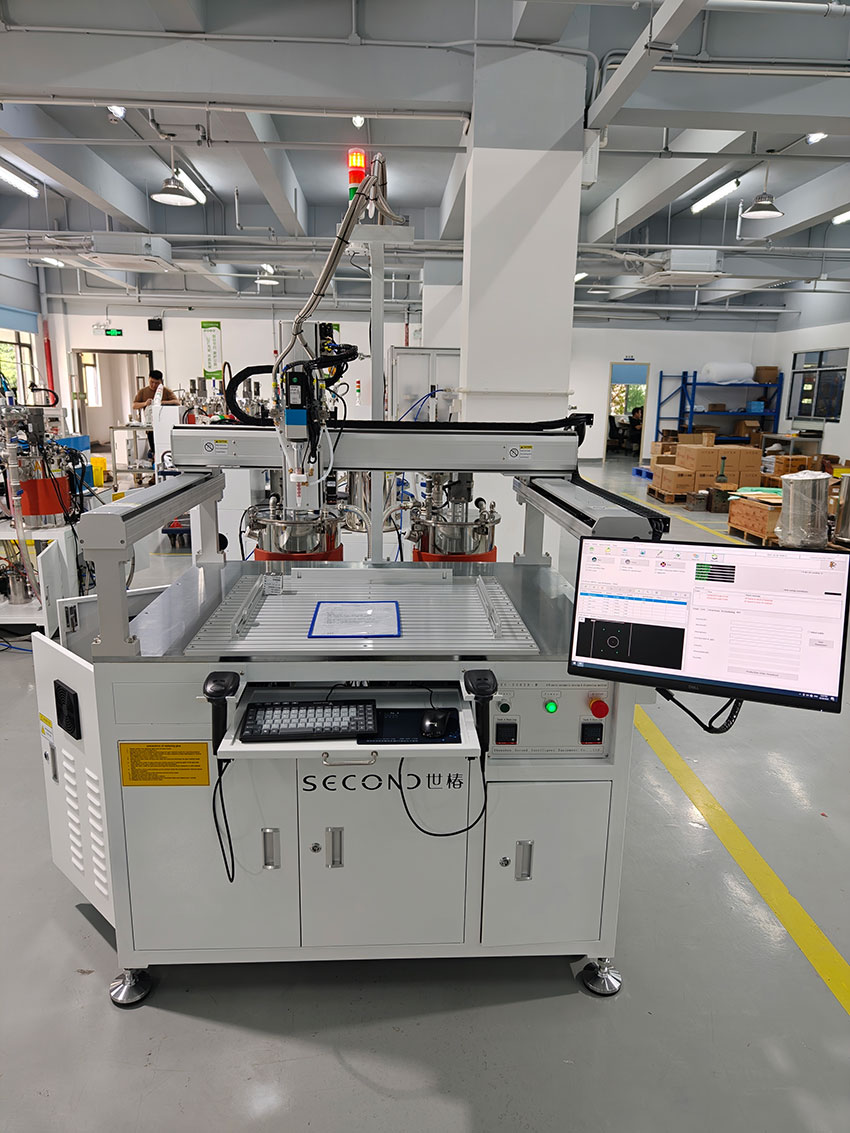
Two-component adhesives (Part A + Part B hardener) cure only after being mixed at the correct ratio; the common systems are epoxy (EP), silicone and polyurethane (PU). Two-component potting is therefore not about dispensing one glue, but about two pumps metering through separate lines and meeting precisely at the valve: any drift in either pump’s output becomes an A:B ratio error, and the consequence is uncured adhesive and full-batch rework. Ratio accuracy is decided by pump selection.
Which three adhesive parameters decide the pump type?
The pump follows the adhesive. Quantify three things before selection:
1.Viscosity: screw pumps handle adhesives from about 0 to 1,000,000 mPa·s; the test is whether the adhesive flows into the pump inlet by gravity — if it does not, use a follower-plate pump for pressurized feed.
2.Filler: calcium carbonate, quartz sand or alumina (a few hundred mesh) is added for thermal conductivity or cost reduction. Filler is the No.1 source of pump wear — gear pumps clog easily with filled adhesives, which is why the industry is shifting to screw pumps and ceramic piston pumps.
3.Mixing ratio and density: the A:B ratio (e.g. 6:1, 10:1) and the density of each component are the raw inputs for the displacement calculation; adhesives exposed to sulfur or phosphorus fail to cure (“adhesive poisoning”), and this decides the stator material.
Five pump bodies: one table to see the boundaries
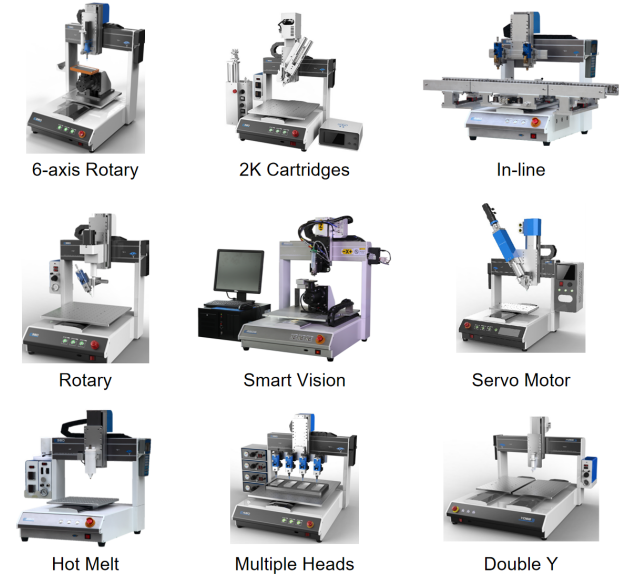
Contact Second Intelligent to discuss your project requirements. Our team can help evaluate your dispensing process and recommend a suitable equipment configuration.
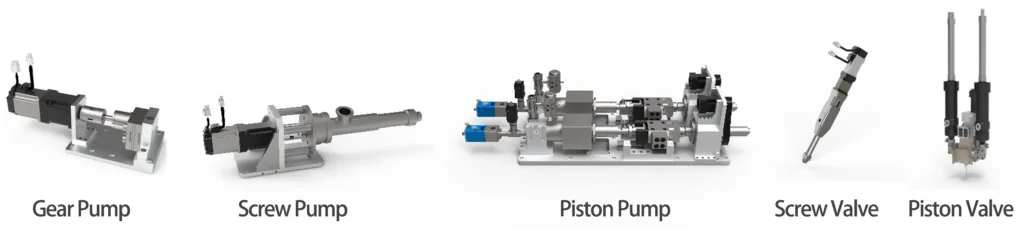
Pump type | Mixing-ratio accuracy | Key pros and cons | Application window |
Gear pump | ±1% | Heat- and corrosion-resistant with continuous duty; poor wear resistance, prone to leaking above 50 kgf; fine fillers cause clogging | Low-viscosity, filler-free, transparent fluids |
Screw pump | ±2% | Wear-resistant and continuous, pressure up to 30 kgf; not corrosion-resistant, stator life of 3–6 months | The workhorse for mid-viscosity filled adhesives |
Ceramic piston pump | ±2% | Pressure up to 100 kgf, excellent wear and corrosion resistance, 3–5 times the life of other pumps; no continuous output | High-viscosity, high-density, high-pressure and high-flow duties |
Micro screw valve | ±0.002 g (based on a 0.05 g shot) | Highest micro-dose accuracy with continuous output; poor wear and corrosion resistance | Micro, continuous precision dispensing |
Micro piston valve | ±0.01 g (based on a 0.1 g shot) | Wear- and corrosion-resistant; non-continuous, not for high pressure | Micro, high-viscosity dotting |
Rule of thumb: low viscosity without filler → gear pump; filled mid-viscosity → screw pump; high viscosity and high pressure → ceramic piston pump; micro high precision → micro screw valve.
How to calculate screw pump displacement? Four steps to lock speed within 0.3–1 rev/s
Screw pumps are sized by displacement per revolution — commonly 0.5 cc, 1.5 cc, 3 cc, 6 cc, 12 cc up to 200 cc. Example: “6 g per part, 4 s cycle time, A:B = 6:1, density of A = 1.5 g/cm3”:
1.Total output: 6 ÷ 4 = 1.5 g/s.
2.Split the A and B mass flows: A = 1.5 × 6/7 ≈ 1.29 g/s; B ≈ 0.21 g/s.
3.Convert to volume flow: 1.29 ÷ 1.5 ≈ 0.86 mL/s.
4.Size the pump: with 0.5 rev/s as the baseline, the required displacement ≈ 0.86 × 2 = 1.72 cc — choose the 1.5 cc pump; verify the actual speed 0.86 ÷ 1.5 ≈ 0.57 rev/s, which falls inside the recommended range.
Speed is the balance point between accuracy and life: below 0.3 rev/s accuracy drops noticeably, while above it wear accelerates at the 3rd–5th power of speed. At the same 1.5 mL/s, a 0.5 cc pump must run at 3 rev/s and wears out fast, while a 6 cc pump at 0.25 rev/s falls below the accuracy floor. After sizing, verify motor torque: 6 cc ≥16 N·m, 12 cc ≥25 N·m, 24 cc ≥50 N·m, 48 cc ≥100 N·m, 96 cc ≥200 N·m.
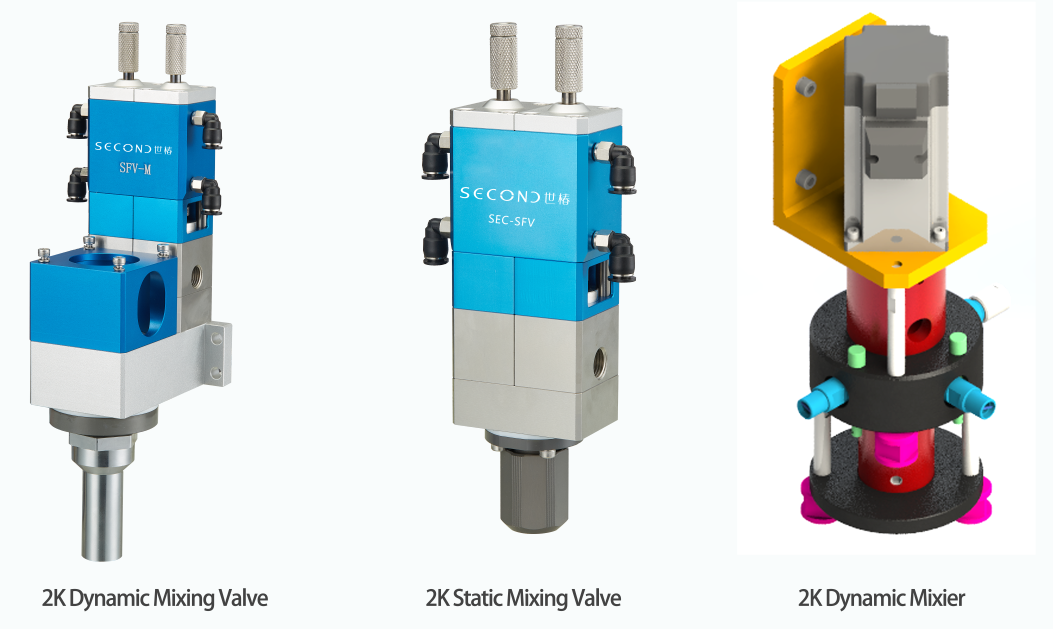
Static valve, dynamic valve or dynamic mixer?
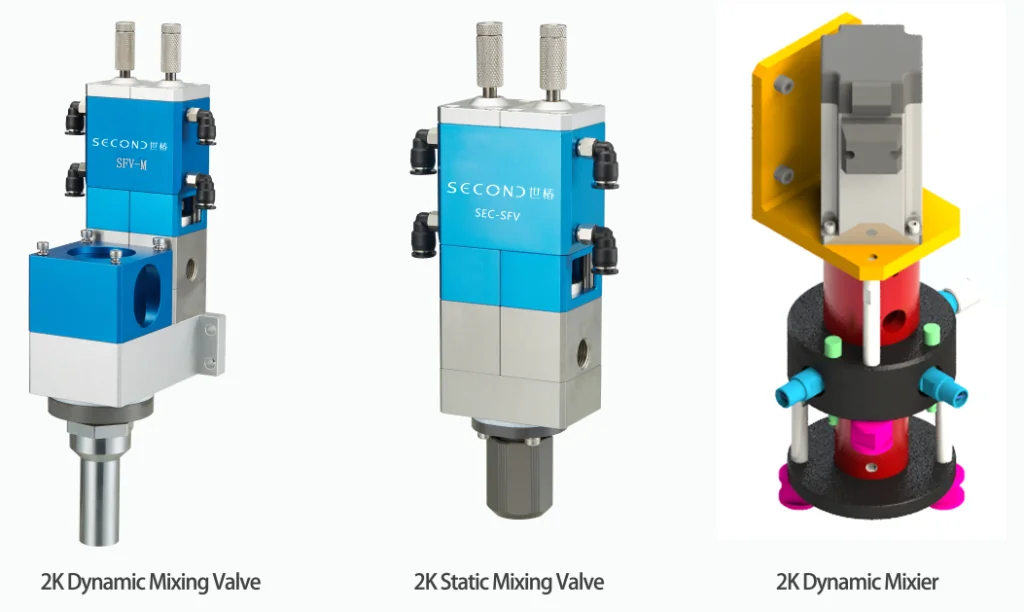
Two-component valve | Key characteristics | Application window |
Static valve | Simple structure and easy cleaning; mixing is insufficient at high viscosity, high ratio or high flow | Similar viscosities and ratios, flow < 20 g/s |
Dynamic valve | Better high-ratio mixing, handles up to 100,000 mPa·s; rotating parts wear and need periodic replacement | The mainstream choice for mid-high viscosity and high ratio |
Dynamic mixer | Strongest mixing at high speed; complex structure, hard to clean | Viscosity > 100,000 cps and output > 30 g/s |
Only three parameters decide: viscosity, ratio and flow. All moderate → static valve; high ratio or mid-high viscosity → dynamic valve; both high → dynamic mixer.
FAQ
1.How viscous an adhesive can a screw pump handle?
About 0–1,000,000 mPa·s; the boundary is whether the adhesive flows into the pump inlet by gravity — if not, use a follower-plate pump for pressurized feed.
2.Why not a gear pump for filled adhesives?
Gear clearances are tight, so a few-hundred-mesh filler wedges into the teeth and accelerates wear, showing up as clogging and a sharp drop in service life; screw pumps have far more tolerant clearances.
3.Does higher speed mean higher potting efficiency?
No. Wear accelerates at the 3rd–5th power of speed, while accuracy suffers below 0.3 rev/s; size the pump backwards from 0.5 rev/s.
Request a free sample test and online selection
The final selection must be verified using the actual adhesive. You may request free sample testing from Second Intelligent by providing details such as the adhesive system (epoxy, silicone, or PU), mixing ratio, dispensing volume per part, and production cycle time. Our professional fluid application engineers will then provide calculations for dispensing volume along with recommendations for pump and valve configurations.