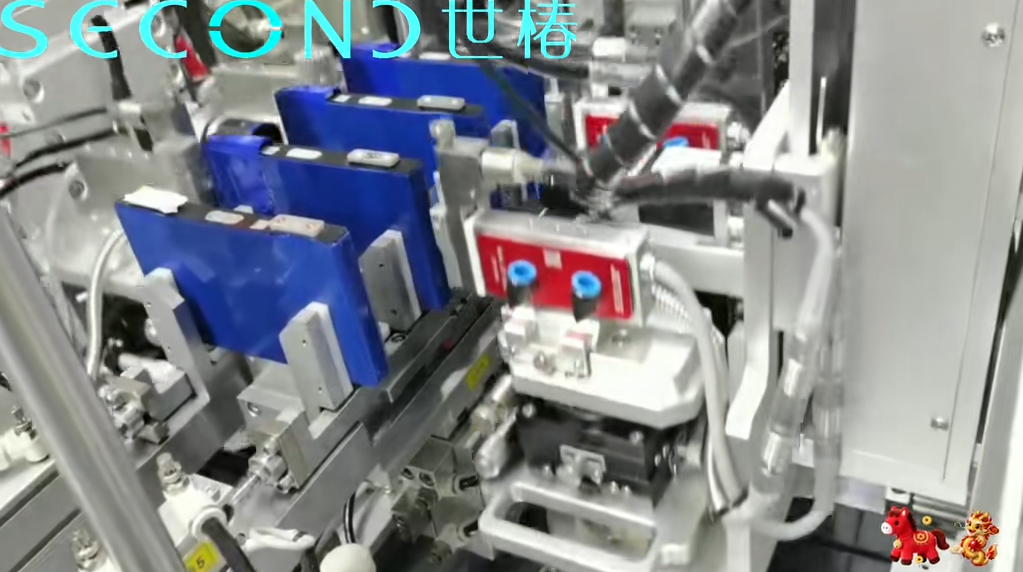
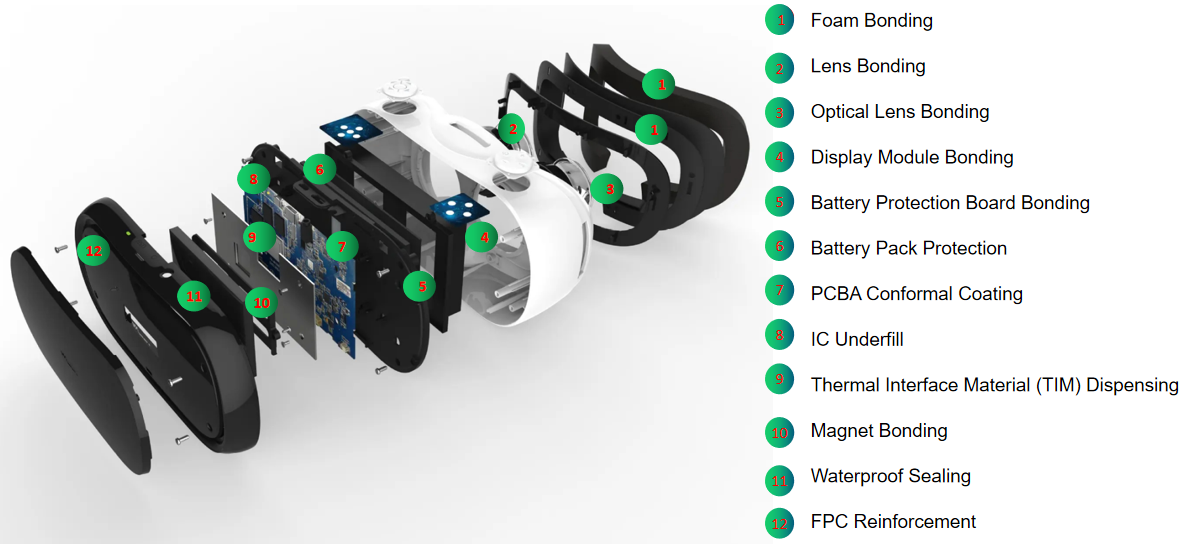
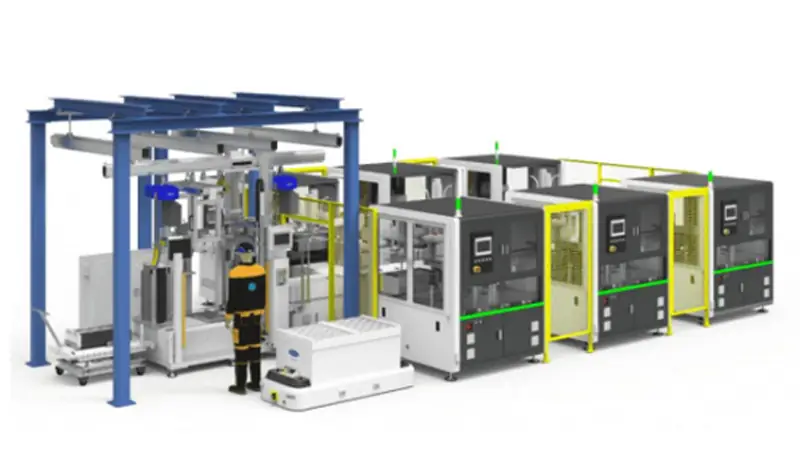
The coating quality of the UV protective adhesive on the sides of lithium-ion batteries directly affects the insulation reliability and long-term safety of the cell. However, the narrow application area, sensitive viscosity window of the adhesive, and stringent production line cycle times make it difficult for traditional contact dispensing methods to balance accuracy and efficiency. Vertical jet dispensing has emerged amidst this dilemma: can it be an effective solution to the challenges of applying UV protective adhesive to the sides of lithium-ion batteries? The answer depends on a deep understanding of the process mechanism and its suitability for various scenarios.
Ⅰ.Why are traditional dispensing methods inadequate for UV protective adhesive on the sides of lithium batteries?
The insulating protective layer on the side of a lithium battery cell plays a crucial role in isolating the cell casing from the external environment and preventing short circuits and electrolyte corrosion. UV-curable adhesives have gained increasing attention in battery insulating protective layer preparation due to their fast curing speed, simple equipment, and ability to eliminate the cumbersome film application process. However, side application has its specific constraints: the application surface is often vertical or near-vertical, posing a risk of adhesive flow before curing; the adhesive layer thickness needs to be uniform and controllable—too thin and the insulation withstand voltage will be insufficient, too thick and it will affect the cell assembly dimensions.
Contact dispensing relies on Z-axis up-and-down movement to dispensing and cutting off the adhesive. The needle needs to be close to the workpiece surface. In the narrow space on the side of the battery, not only is the speed limited, but there is also a risk of the needle colliding and damaging the cell or scratching the adhesive layer. More importantly, the moment the adhesive breaks during contact dispensing, it is easy to leave a trail or string at the end of the adhesive line. For applications like side UV adhesives that require clear outlines and no collapse before curing, the edge quality after curing is difficult to guarantee.
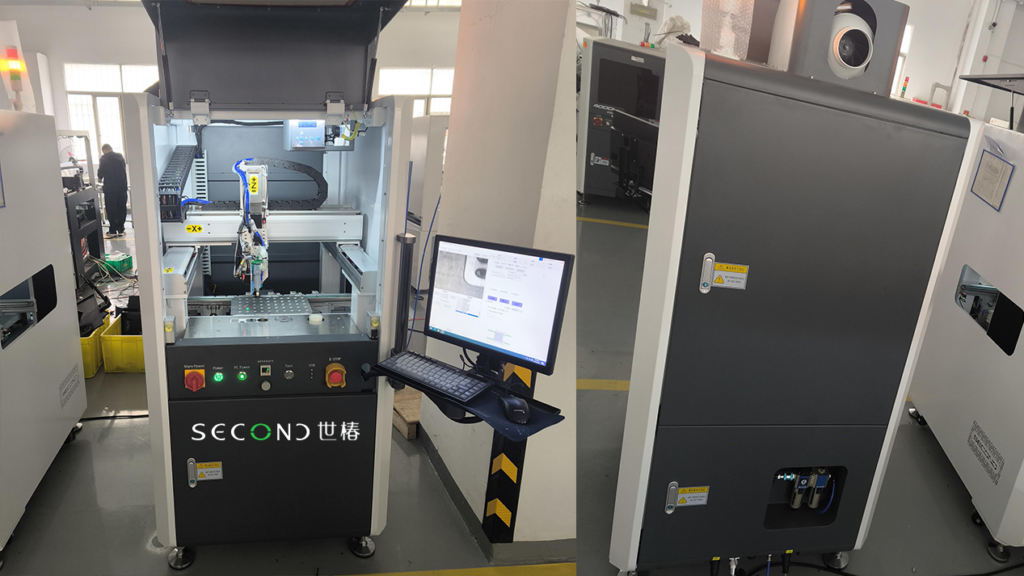
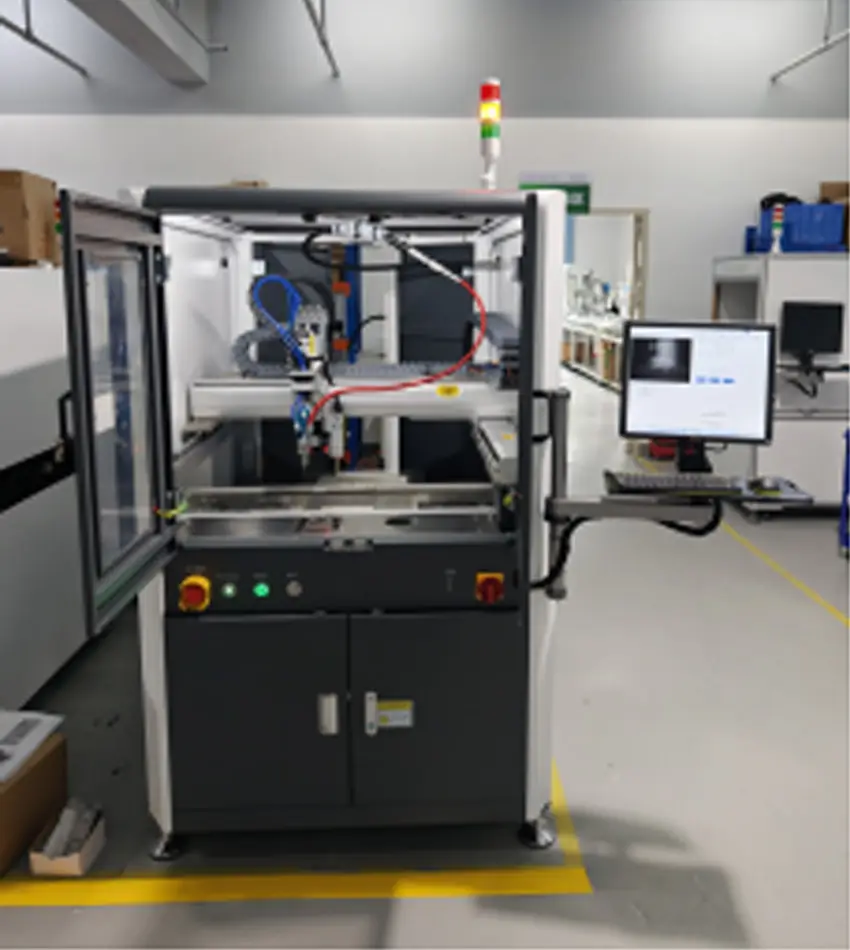
Automatic In-line PCB Glue Dispensing Machine SEC-DH400L
Second Intelligent In-line Glue Dispensing Machine SEC-DH400L adopts an integrated mineral casting design, with ultra-high precision and super stability, powerful expansion capabilities, and can realize ion cleaning, dispensing, detection, UV exposure and other functions;
Adopting a gantry structure, it can bear large loads, stable structure, and a powerful CCD visual positioning system, which can meet the requirements of Mark point positioning, edge positioning, and 3D scanning positioning; strong scalability, and can expand AOI detection 3D detection, UV exposure curing and other functions;
Strong platform compatibility, contact and non-contact dispensing, single-head and multi-head synchronous dispensing, automatic compensation and adjustment of double-head spacing, five-axis dispensing machine function based on needle A/R displacement, etc.
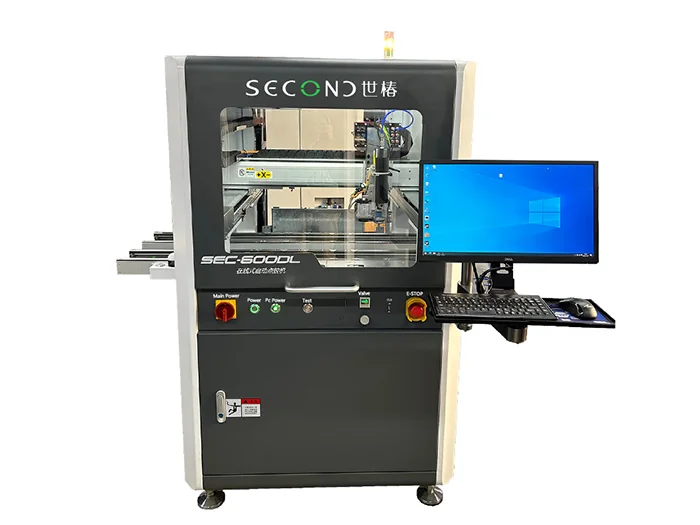
High precision In-line glue dispensing machine SEC-DH600L
Ⅱ.Vertical Jet Dispensing: How Does It “Solve” the Precision Challenge of Side Application?
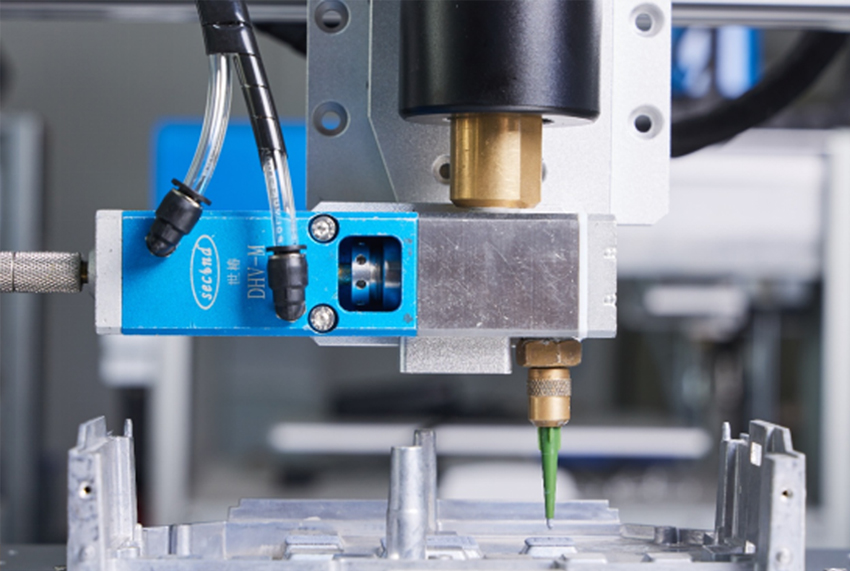
The core logic of vertical jet dispensing lies in the word “non-contact.” The Piezoelectric jet valve uses piezoelectric or pneumatic drive to propel a high-speed impact pin against the nozzle, depositing the adhesive onto the substrate surface in a jetting motion, eliminating the need for Z-axis vertical movement. This mechanism offers two direct benefits: First, the adhesive droplets possess definite kinetic energy and directionality upon exiting the nozzle. Vertical jetting is particularly suitable for adhesive deposition on vertical side surfaces, as the spread of the droplets after impact is controllable, preventing significant dripping due to gravity. Second, it eliminates Z-axis movement time, allowing for jetting frequencies of hundreds to thousands of times per second, far exceeding the cycle time of contact dispensing.
For the material characteristics of UV protective adhesives, the adaptability of vertical jetting also lies in adhesive viscosity management. UV adhesives for lithium battery sides typically need to balance flowability and thixotropy: flowability ensures smooth jetting without nozzle clogging, while thixotropy ensures the adhesive droplets maintain their shape and do not flow after application. Piezoelectric jet valves offer high precision control over low-to-medium viscosity fluids. Combined with a symmetrically designed valve body, they effectively eliminate horizontal interference forces during needle movement, reducing scattering and adhesive buildup. This means that in narrow areas like the side of a battery, vertical jetting can achieve smaller dot diameters and denser spacing, forming a continuous and neatly edged protective adhesive line.
III. From “Can Spray” to “Spray Well”: How to Determine the Process Window for Vertical Jet Dispensing?
Vertical Piezoelectric jet valve dispensing is a mature technology, but its application to UV protective adhesives on the sides of lithium batteries still requires process convergence across three parameter dimensions.
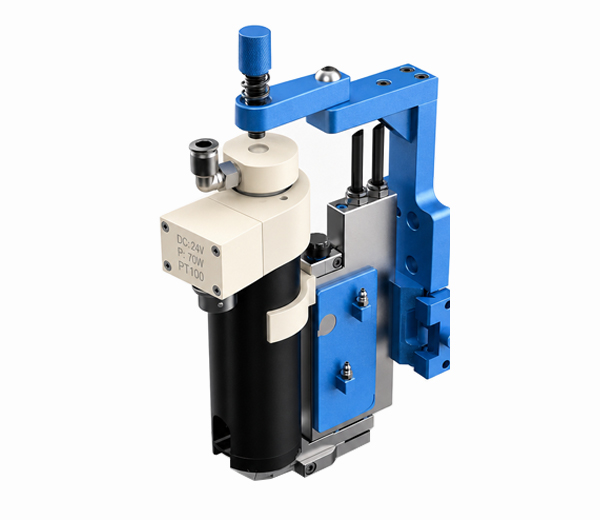
Piezoelectric Jet Valve F-P102
The spacing and overlap rate of adhesive dots are the primary variables determining the continuity of the adhesive line. Spray dispensing forms a discrete sequence of adhesive dots. If the spacing between dots is greater than the droplet spreading diameter, a discontinuous “bead chain” structure will appear after curing, resulting in weak points in insulation and withstand voltage performance. Typically, the spacing needs to be calculated by working backward from the amount of adhesive applied per dot and the target adhesive width on the side, allowing adjacent dots to slightly overlap and fuse before curing. For long, strip-shaped application areas like the side of a battery, the spray valve must maintain consistent dot spacing during high-speed movement, which places demands on the synchronization accuracy of the motion platform and the spray frequency.
Matching the spray frequency with the prfdgsoduction line cycle time is equally crucial. The speed advantage of spray dispensing can only be translated into actual production capacity when coordinated with the robotic arm’s movement speed. If the spray frequency is too high and the movement speed is too slow, adhesive dots will accumulate excessively; conversely, insufficient adhesive will result. Considering that lithium battery production lines typically measure cycle time in PPM (particles per minute), the process development phase needs to use the target cycle time as a constraint to reverse-determine the parameter combination of single-dot adhesive amount, dot spacing, and movement speed.
The leveling time of UV adhesives before curing is also crucial. UV adhesives sprayed to the side have a brief liquid window before entering the curing lamp. Vertical spraying has the advantage that the adhesive droplets impact the substrate at a certain speed, making the spreading behavior more controllable than natural dripping. However, if the adhesive viscosity is too low or the thixotropic recovery is too slow, an uneven cross-section with a thicker bottom edge and a thinner top edge may still occur while waiting for curing. When selecting a UV adhesive, the thixotropic index should be considered, and the dwell time on the transport path from dispensing to curing should be minimized as much as possible.
Ⅳ.In which scenarios is vertical jet dispensing a “must-have” for lithium-ion battery UV protective adhesive?
Not all lithium-ion battery UV protective adhesive applications require vertical jet dispensing. If the application surface is the horizontally facing top or bottom of the cell, and the cycle time requirement is not high, contact dispensing still has its place due to lower equipment investment and wider fluid adaptability. However, the priority of vertical jet dispensing increases significantly in the following situations:
Side application with limited space. The side of a square aluminum-cased cell offers extremely limited operating space for the dispensing equipment. Contact needles need to be tilted or inserted laterally, making operation difficult and increasing the risk of collision. The jet valve only needs to be positioned above or slightly above the application surface at a fixed working distance to complete non-contact deposition, offering better space adaptability.
High-cycle production lines. When the production line speed requires the dispensing process to complete the coating of a single cell side within seconds, the Z-axis round-trip time of contact dispensing becomes a bottleneck. By eliminating Z-axis movement, jet dispensing increases the adhesive deposition frequency by more than an order of magnitude, making it a necessary choice for high-speed production lines. Strict requirements are placed on the edge quality of the adhesive layer. If jagged edges, trailing, or scattered splashes appear at the edges after the UV protective adhesive has cured, it not only affects the pass rate of appearance inspection, but the tiny splashed adhesive particles may also contaminate other functional areas of the battery cell. Vertical spraying, by optimizing nozzle geometry and drive waveform, can significantly reduce the satellite droplet occurrence rate. Combined with the elimination of horizontal interference forces by the symmetrical valve body structure, the edge neatness is superior to contact-type adhesive forming.
Returning to the initial question: Can vertical jetting dispensing solve the application challenges of UV protective adhesive on the sides of lithium batteries? The answer is yes, but only if the process parameters are systematically calibrated and the adhesive characteristics match the fluid window of the spraying valve. It is not a universal replacement, but rather the most worthwhile technical route to be verified under the triple constraints of “narrow surface, high speed, and high consistency.” The value of vertical spraying dispensing lies not in the spraying itself, but in its advancement of side adhesive application from “whether it can be applied” to “whether it can be applied controllably, repeatedly, and in mass production.”
FAQ:
Q1: What is the difference between vertical spray dispensing and regular spray dispensing?
Vertical spraying emphasizes the relative relationship between the spray direction and the application surface. Regular spray dispensing is mostly used on horizontally facing substrates, where the adhesive droplets spread with the aid of gravity. Vertical spraying faces vertical or inclined sides, requiring the adhesive droplets to rely on their own kinetic energy and wettability to adhere and spread. Therefore, it places higher demands on the matching of spraying speed, droplet volume, and adhesive thixotropy. There is no fundamental difference at the equipment level; the difference lies in the process parameters and adhesive selection.
Q2: What viscosity range should the UV protective adhesive for the sides of lithium batteries be controlled within?
There is no uniform standard value, but generally speaking, it is recommended that the UV adhesive for vertical spraying have medium viscosity and significant thixotropy. If the viscosity is too low (e.g., close to water), the adhesive droplets will easily flow on the vertical surface after spraying, resulting in uneven thickness of the adhesive line; if the viscosity is too high, it places higher demands on the driving capability of the spray valve, and the adhesive droplets will not spread sufficiently, requiring a smaller dot spacing to form a continuous adhesive line, affecting efficiency. The actual window size needs to be determined by combining the spray valve model and the rheological data of the adhesive supplier.
Q3: Will spray dispensing produce splatter or satellite droplets, contaminating the battery cell?
This is one of the key risks that needs to be controlled in the spray process. Satellite droplet formation is related to adhesive buildup in the nozzle, improper drive waveform, or air bubbles in the adhesive. By using a symmetrically designed spray valve, keeping the nozzle clean, degassing the adhesive, and optimizing the impact pin stroke and impact speed, splatter can be controlled within acceptable limits. In side-mounted adhesive application to batteries, it is recommended to use a high-speed camera to confirm the droplet flight attitude during the process verification stage and to set up regular nozzle cleaning cycles in mass production.
Q4: What is the controllable adhesive layer thickness for vertical spray dispensing?
The adhesive layer thickness of a single spray depends on the amount of adhesive applied per dot, the dot spacing, and the solid content of the adhesive. For UV protective adhesive on the sides of lithium batteries, the common dry film thickness requirement is in the tens to hundreds of micrometers range. Jet dispensing allows for precise control of single-point volume by adjusting valve opening time and frequency. Combined with reasonable dot spacing and overlap, this achieves uniform wet film thickness. UV adhesives dispensing with stable shrinkage after curing can achieve the target dry film thickness. Specific values should be based on curing shrinkage data and measured film thickness provided by the adhesive supplier.
Q5: Is this process route suitable for upgrading existing production lines?
The feasibility of upgrading is relatively high. Jet dispensing systems are typically implemented as independent dispensing modules or integrated with robots, requiring no major modifications to the battery cell transmission lines. Key modification points include: confirming whether the space at the dispensing station can accommodate the jet valve and adhesive supply pipeline; whether the position of the UV curing lamp needs adjustment to match the adhesive trajectory after spraying; and whether the electrical control system has a jet trigger signal synchronized with the production line PLC. Compared to replacing the entire coating process (such as changing from film application to spraying), the implementation threshold for vertical jet dispensing is relatively controllable, making it suitable as an incremental upgrade solution for side UV adhesive coating.